| 10 People Are Viewing This Product Right Now |
Is a Dual Fuel Generator Worth It? Real Costs, Power Limits, and Fuel Truths
Dual Fuel Generator – Imagine a winter storm has just knocked out your power. You need to keep the heat on, the sump pump running, and your refrigerator cold. You head to your generator only to realize your gasoline has gone bad after sitting for months, or worse, the local stations have run dry. This exact scenario is why dual fuel generators have surged in popularity—they give you a crucial Plan B.
But is a dual fuel generator really worth the investment for your home? The short answer is: it depends entirely on your needs, but for many, the flexibility is a game-changer. A dual fuel generator is a versatile power source that can operate on two types of fuel, typically gasoline and propane, allowing you to switch based on availability, cost, or the situation at hand.
In this guide, we’ll break down the complexities, from understanding the “20/20/20 rule” to calculating if a 12,500-watt generator can truly run your entire house. We’ll weigh the pros and cons so you can decide if dual fuel is a smart buy or just an extra complication.
Understanding Dual Fuel Technology: More Than Just a Backup Plan
Let’s start by getting under the hood. A dual fuel generator isn’t just two engines slapped together; it’s a single, intelligent system designed to accept two different fuel types.

1. How Does a Dual Fuel Generator Work?
Think of it like a car that can seamlessly switch between premium and regular gasoline, but for your entire house. These generators have a specialized carburetor or fuel injection system and a switching mechanism.
When you switch from, say, gasoline to propane, valves adjust the fuel flow, and the engine management system tweaks the air-fuel mixture and ignition timing to optimize performance for the new fuel. Some models can even switch automatically when one fuel source runs low.
2. The Nuts and Bolts: Gasoline vs. Propane Operation
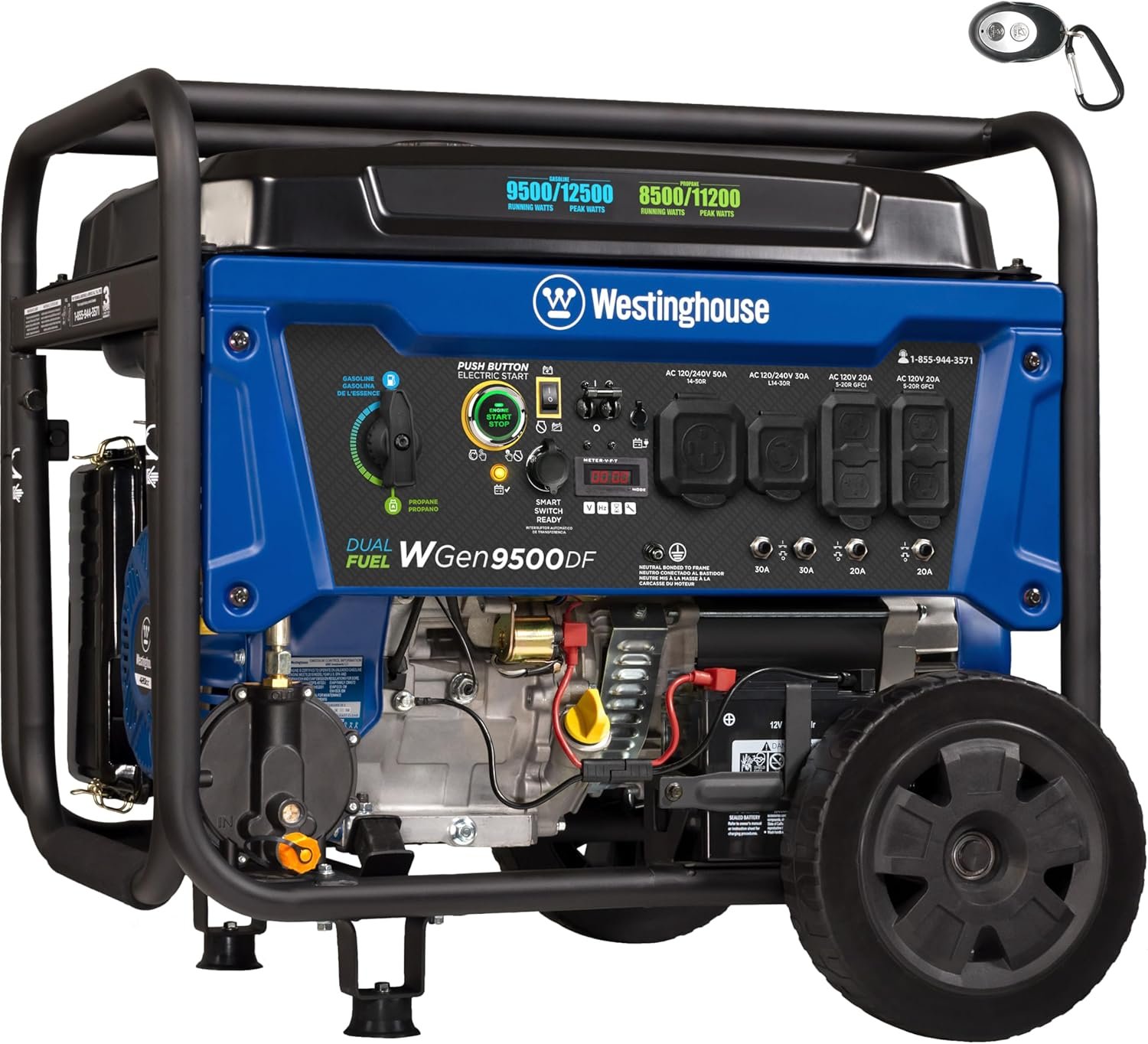
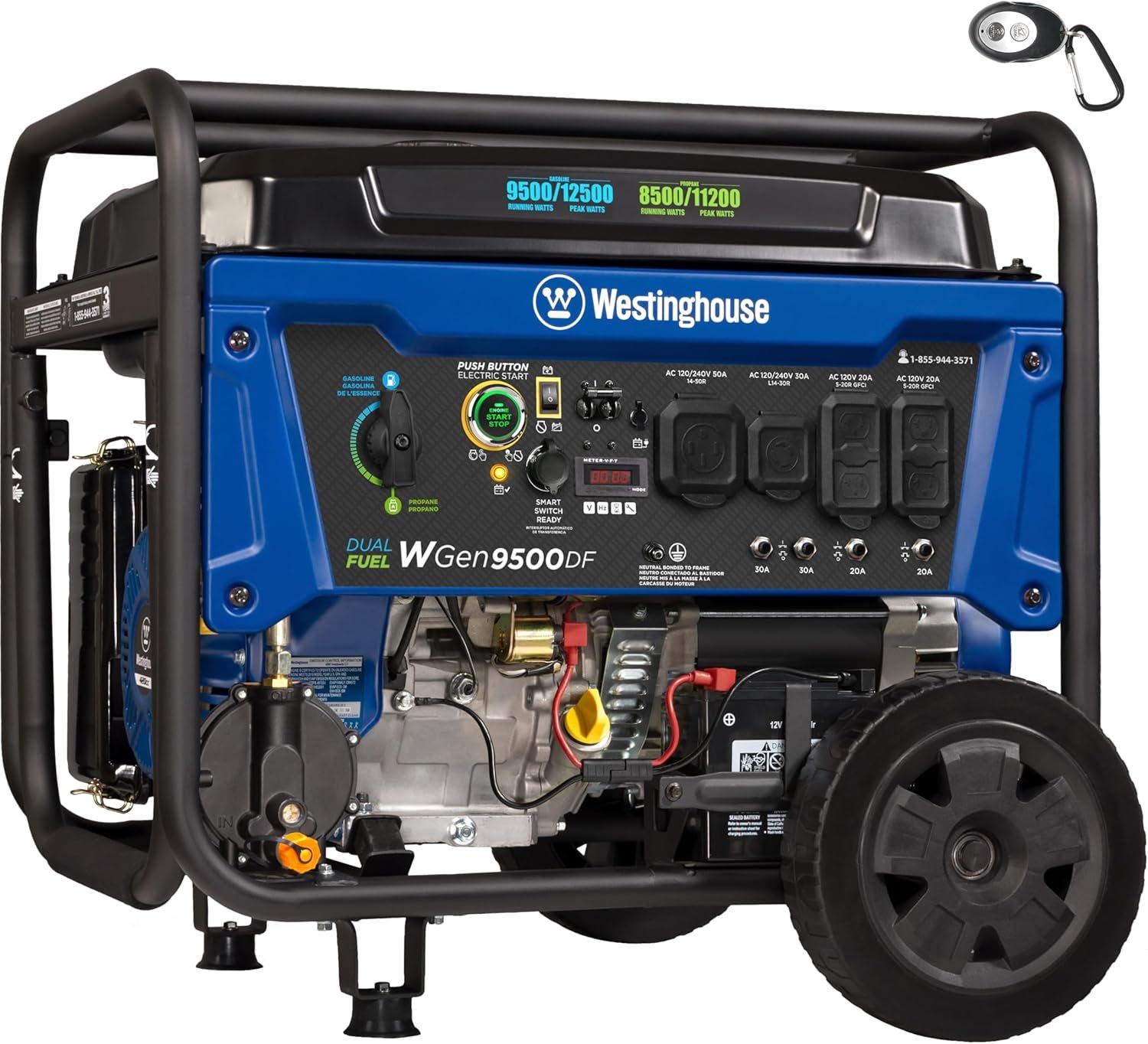
It’s important to know that performance varies by fuel. Using a popular model like the Westinghouse WGen9500DF as our benchmark, you’ll see a clear difference: on gasoline, it delivers 12,500 peak watts and 9,500 running watts.
On propane, those numbers dip slightly to 11,200 peak and 8,500 running watts. You trade a bit of power for the benefits of propane. The generator can switch between these fuels without shutting off, providing uninterrupted power during a critical outage.


The Great Debate: Weighing the Pros and Cons of Dual Fuel
Is dual fuel right for you? Let’s break down the compelling advantages and the honest-to-goodness drawbacks.
1. The Compelling Advantages of Going Dual Fuel
- Unmatched Fuel Flexibility and Preparedness: This is the headline feature. In an extended emergency, one fuel type might become scarce. With a dual-fuel unit, you have options. Propane is often easier to find and stockpile than gasoline during a widespread crisis.
- Extended Runtime: You effectively double your fuel reserve. When the 6.6-gallon gasoline tank on the Westinghouse runs dry after up to 12 hours, you can immediately switch to a propane tank and keep going for another 7 hours.
- Simpler Fuel Storage and Maintenance: Here’s where propane shines. Gasoline degrades in as little as 3-6 months, gumming up your carburetor. Propane has an almost indefinite shelf life, making it perfect for long-term emergency storage. It also burns cleaner, producing fewer carbon deposits and leading to less engine wear over time.
- Environmental and Operational Benefits: Propane burns cleaner than gasoline, resulting in lower emissions and a smaller carbon footprint. It also typically means a quieter generator, which is a blessing for you and your neighbors during a multi-day outage.
2. The Real-World Disadvantages to Consider
- Higher Initial Investment: You pay for versatility. Dual fuel generators carry a higher upfront cost compared to comparable single-fuel models.
- Slightly Reduced Power on Propane: As noted, you’ll get about 10-15% less power when running on propane. You must factor this into your sizing calculations.
- Added Operational Complexity: You’re managing two fuel systems. This means understanding the different runtimes, connection methods, and having a safe storage plan for both gasoline and propane tanks.
- Fuel Storage Logistics: While propane stores well, you now need space for both propane tanks and approved gasoline containers. Local fire codes often restrict how much gasoline you can store on a residential property.
| Feature | Gasoline | Propane (LPG) |
|---|---|---|
| Power Output | Higher (Full engine capacity) | Slightly Lower (~85-90% of gas output) |
| Fuel Shelf Life | Short (3-6 months, needs stabilizer) | Very Long (Indefinite, no degradation) |
| Storage Safety | Volatile, strict fire code limits | Stable, easier to store safely |
| Environmental Impact | Higher emissions | Cleaner-burning, lower emissions |
| Typical Cost & Availability | Subject to market fluctuations, it may be scarce in crises | Often more stable, tanks are portable & swappable |
Sizing Up Your Needs: Will a 12,500-Watt Generator Run Your Whole House?
This is the million-dollar question (or, more accurately, the two-thousand-dollar question). The label “12,500 watts” sounds huge, but will it power your 2,000 sq. ft. home?
1. Understanding “Running” vs. “Starting” Watts
The key is understanding the difference between Running Watts (continuous power) and Starting Watts (the brief surge needed to start motor-driven appliances like ACs or refrigerators).
A 12,500-watt generator like the Westinghouse WGen9500DF has a running wattage of 9,500W on gas. You must size your generator based on the total running watts of the appliances you’ll use simultaneously, plus the largest starting watt surge in that mix.
2. What Can You Realistically Power?
A 9,500-running-watt generator is substantial. It can typically handle:
- Central Air Conditioning: A 3-4 ton unit (requires careful checking of its specific starting surge, often 6,000-9,000W).
- Sump Pump & Refrigerator/Freezer
- Electric Water Heater (a major draw at ~4,500 running watts).
- Lights, TV, Chargers, and a Microwave.
However, you cannot run all of these at once. For example, running a central AC (3,000W running), an electric water heater (4,500W running), and a refrigerator (800W running) simultaneously already exceeds 8,300 running watts, leaving little headroom. This is where load management—using a transfer switch to prioritize circuits—becomes essential.
3. The Verdict for a 2,000 sq. ft. Home
While industry guidelines often recommend 16,000 to 24,000 watts for full-house backup on a 2,000 sq. ft. home, a 12,500-watt (peak) generator is in the “large portable” category. It can absolutely run a majority of your home and all critical systems, but you will likely need to be selective.
It’s perfect for powering essential circuits and several major appliances, but not necessarily for restoring every single outlet to normal operation simultaneously. For true whole-house coverage without management, a larger standby generator (18kW+) is often recommended.

Practical Operation and Safety: Rules You Can’t Afford to Ignore
Owning a generator comes with serious responsibilities. Let’s demystify the critical rules for safe and effective operation.
1. The Critical 20/20/20 Rule for Placement
Your generator’s location is a matter of life and death due to the risk of carbon monoxide (CO) poisoning. The easy-to-remember 20/20/20 rule provides a solid safety baseline:
- 20 feet from your home, windows, doors, and vents.
- 20 inches off the ground to protect from water and flooding.
- 20 feet from flammable materials like fuel tanks or dry brush.
Always point the exhaust away from your home, and never, ever operate a generator in an enclosed space like a garage, even with the door open.
2. The Other 20/20/20 Rule for Maintenance
Confusingly, there’s a second 20/20/20 rule for maintenance. It states you should run your generator for 20 minutes every 20 days at a 20% load. This simple habit circulates oil, prevents fuel system gunk, keeps the battery charged, and ensures it’s ready when disaster strikes. Remember, “20% load” means you need to plug in a few appliances—never run it completely empty.
Fuel Economics and Longevity: The Real Cost of Running
Let’s talk numbers. How long will your fuel last, and what’s the cheaper option?
1. Propane Consumption and Runtime
Using our Westinghouse example:
- On a standard 20 lb propane tank (like for a grill), it will run for about 7 hours at a 50% load.
- A larger 100 lb tank would therefore provide roughly 35 hours of runtime at the same load.
- Propane consumption for a 12kW-class generator is roughly 0.67 gallons per hour (note: propane is measured in pounds; a 20 lb tank holds about 4.7 gallons of liquid propane).
2. Gas vs. Propane: Which is Cheaper to Run?
The answer fluctuates with fuel prices, but here’s the breakdown:
- Gasoline typically provides more energy per gallon, so your generator will produce more watts on gas, making it potentially more efficient in terms of power output per dollar.
- Propane is often cheaper per gallon and has a stable shelf life, eliminating the cost and hassle of fuel stabilizers and degraded gas.
The “cheaper” fuel depends entirely on your local prices at any given time. The real savings with propane come from reduced maintenance costs and never having to dispose of old, gummy gasoline.
3. The 80/20 Rule for Propane Tanks
This is a critical safety and efficiency tip: never fill a propane tank beyond 80% capacity. This “ullage” space allows the liquid propane to safely expand as it warms. Overfilling can cause dangerous pressure buildup and potentially release gas through the relief valve.

Conclusion: Making Your Decision
So, is a dual fuel generator worth it? If you value maximum preparedness, flexible fuel options, and long-term storage capability, the answer is a resounding yes. The ability to run on indefinitely-stable propane is a huge advantage for emergency backup. The initial cost is balanced by resilience and potential maintenance savings.
However, if your power outages are infrequent and brief, you have easy access to fresh gasoline, and you want the absolute maximum power from a portable unit, a traditional gas generator might suffice.
For the homeowner seeking peace of mind, a dual fuel generator like a 12,500-watt model is a powerful Swiss Army knife. It won’t invisibly power every single thing in a large home, but with smart load management, it will keep your family safe, comfortable, and connected through almost any storm. It’s not just a generator; it’s an insurance policy with two separate fuel sources to back it up.
FAQs
- Can I really switch between propane and gas while the generator is running?
Yes, that’s a key feature of most true dual fuel generators. They are designed to allow on-the-fly switching without needing to shut down, providing seamless backup power during a transition. - What kind of gasoline should I use in my Westinghouse generator?
Use clean, fresh unleaded gasoline with a minimum octane rating of 87. To prevent ethanol-related damage in models not designed for it, use gasoline with no more than 10% ethanol (E10), and always add a fuel stabilizer for any gas that will sit for more than a month. - Will a dual fuel generator have more engine problems?
Not necessarily. While the system is more complex, using propane actually reduces carbon buildup and can lead to less engine wear over time. The main issues arise from a lack of maintenance or using old, degraded gasoline in the system. - Is it better to run my generator on natural gas instead of propane?
Some “tri-fuel” generators offer natural gas as a third option. Natural gas is convenient if you have a home line and is often cheaper, but it provides even less power than propane. For portable backup, propane is the more common and practical alternative fuel. - What’s the single biggest mistake people make with portable generators?
Placement. Putting the generator too close to the house, near an open window, or in an enclosed space like a garage is the leading cause of preventable carbon monoxide deaths. Always follow the 20/20/20 placement rule and install battery-operated CO alarms in your home. - How Long Will a 20 lb Propane Tank Run a Generator?
This depends on load size and generator efficiency.
Typical Runtime Estimates- 25% load: 7–9 hours
- 50% load: 4–5 hours
- 75% load: 3 hours
- Will a 12,000 Watt Generator Run Central Air?
Sometimes—but it depends on the AC unit.
Central AC Power Needs- Running watts: 3,000–5,000
- Starting watts: 6,000–8,000
- Will a Generator Run a Hot Water Heater?
Electric Water Heater- Requires 4,500–5,500 watts
- Heavy startup draw
- Easy to power
- Only needs electricity for ignition
| Westinghouse Generator Collections | |
|---|---|
 |  |
| Check Amazon Discount | Check Walmart Discount |
You Might Also Like: