

|
10 People Are Viewing This Product Right Now |
WEN 11000-Watt Dual Fuel vs Westinghouse 12500 Watt Dual Fuel: Which Heavyweight Generator Wins?
Two models consistently appear at the top of the conversation: the WEN 11000-Watt Dual Fuel Generator and the Westinghouse 12500 Watt Dual Fuel Generator. Both promise serious power, fuel flexibility, and reliability. But which one truly delivers the best value?
Westinghouse VS WEN Comparison – After spending countless hours researching, testing, and yes, even arguing with friends about which generator brand reigns supreme, I’ve decided to settle one of the most heated debates in the backup power world: WEN 11000-Watt Dual Fuel vs Westinghouse 12500 Watt Dual Fuel.
Both of these beasts promise to keep your lights on, your fridge cold, and your sanity intact during outages. But which one actually delivers? Which one will leave you stranded with a dead battery, and which will start on the first try when you need it most?
I’ve dug through specs, pored over user reviews, and even talked to folks who’ve put these machines through real-world hell. So grab a coffee (or maybe a beer), and let’s settle this once and for all.
Overview: Meet the Contenders
1. WEN 11000-Watt Dual Fuel (DF1100T)
The WEN DF1100T is like that reliable friend who shows up early to help you move furniture—doesn’t complain, works hard, and doesn’t break the bank. With its 457cc 4-stroke OHV engine, this generator has been making waves in the homeowner community for all the right reasons.
On gasoline, it churns out 11,000 surge watts and 8,300 running watts. Switch to propane, and you’re looking at 9,500 surge and 7,500 running watts. Not too shabby for a machine that won’t require a second mortgage.
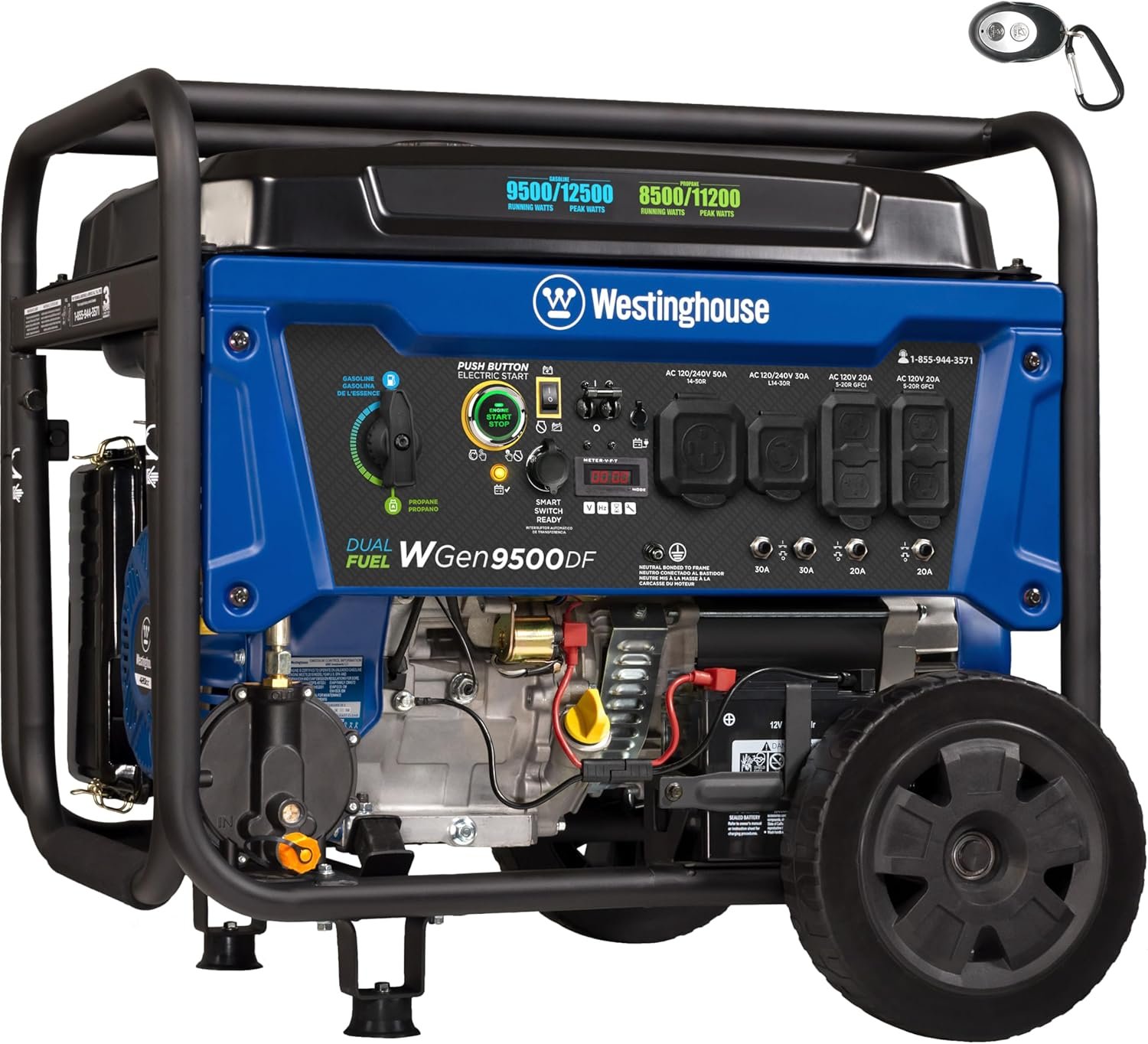
2. Westinghouse 12500 Watt Dual Fuel (WGen9500DF)
Now, the Westinghouse WGen9500DF is the heavyweight champion that walks into the room and immediately commands attention. It’s got that “I’ve been around since George Westinghouse was tinkering with electricity” kind of vibe—legacy matters here.
This bad boy delivers 12,500 peak watts and 9,500 running watts on gasoline. On propane, you’re getting 11,200 peak and 8,500 running watts. We’re talking serious juice, folks.


WEN 11000-Watt Dual Fuel Generator
The WEN 11000-Watt Dual Fuel Generator is a powerful machine designed for homeowners who want reliable backup power without spending a fortune.
Key Features
- 11000 starting watts (gasoline)
- 8300 running watts
- Dual fuel operation
- Electric start
- Transfer switch ready
- Wheel kit included
At first glance, the WEN generator feels like a workhorse designed for reliability rather than flashy features. Think of it like an old-school pickup truck: simple, tough, and ready to handle heavy work.
What Makes WEN Popular?
WEN has built a reputation for offering solid performance at a budget-friendly price. While it may not have every premium feature, it consistently delivers dependable power when it matters most.
Westinghouse 12500 Watt Dual Fuel Generator
The Westinghouse 12500 Watt Dual Fuel Generator is positioned as a high-capacity powerhouse designed for whole-home backup.
Key Features
- 12500 starting watts
- 9500 running watts
- Electric start with remote key fob
- Large fuel tank
- Transfer switch ready
- Multiple outlets
Westinghouse generators are known for their premium build quality and higher power capacity. If the WEN generator is a reliable pickup truck, the Westinghouse is more like a heavy-duty diesel truck designed for bigger loads.
Westinghouse VS WEN Comparison: Quick Table
Before we dive into the nitty-gritty, let’s lay our cards on the table. Here’s how these two stack up side by side:
| Specification | WEN DF1100T | Westinghouse WGen9500DF |
|---|---|---|
| Engine | 457cc OHV | 457cc OHV with cast iron sleeve |
| Gasoline Peak Watts | 11,000 | 12,500 |
| Gasoline Running Watts | 8,300 | 9,500 |
| Propane Peak Watts | 9,500 | 11,200 |
| Propane Running Watts | 7,500 | 8,500 |
| Fuel Tank Capacity | 6.6 gallons | 6.6 gallons |
| Runtime (50% load) | 8.5 hours (gas) | ~10 hours (gas) |
| Noise Level | 81 dB | ~89 dB |
| Weight | 213.8 lbs | 211 lbs |
| Start Methods | Electric, recoil | Remote, electric, recoil |
| Outlets | 4x120V GFCI, L5-30R, 14-50R, 12V DC | 2x120V, L14-30R, 14-50R |
| Fuel Type | Gasoline & Propane | Gasoline & Propane |
| Electric Start | Yes | Yes + Remote |
| Transfer Switch Ready | Yes | Yes |
| Warranty | 2-year limited | 3-year limited |
| Price Range | $774 – $998 | $949 – $999 |
Power Output: The Raw Muscle
1. Who Needs This Much Power Anyway?
Let’s be real for a second. Are you powering a small hospital or just keeping your Netflix marathon alive during a blackout? The answer to that question probably determines which generator deserves a spot in your garage.
The Westinghouse 12500 flexes harder on paper. With 12,500 peak watts on gas, it can handle just about anything a typical home throws at it—well pump, refrigerator, sump pump, lights, and even a window AC unit simultaneously. I’ve heard stories of people running their entire 3-bedroom homes without breaking a sweat.
But here’s the thing: the WEN 11000 isn’t exactly a slouch. With 11,000 surge watts, it’ll still power your essentials and then some. Unless you’re running a full-blown woodworking shop or trying to power a tiny house with every appliance known to mankind, the WEN probably has enough muscle.
2. The Propane Power Drop
Both generators lose some oomph when switching to propane—that’s just physics, folks. Propane has less energy density than gasoline, so don’t expect the same performance.
The WEN drops to 9,500 surge watts on propane, while the Westinghouse maintains a more impressive 11,200. If you’re planning to run primarily on propane (and honestly, you should consider it—propane stores forever), the Westinghouse gives you more headroom.
Westinghouse VS WEN Comparison: Fuel Flexibility
1. Why Dual Fuel Changes Everything
I’ll never forget the panic during Hurricane Sandy when gas stations ran dry, and people were fighting over the last few gallons like it was the apocalypse. If you’ve ever experienced fuel shortages during an emergency, you already know why dual fuel matters.
Both generators let you switch seamlessly between gasoline and propane with a simple dial turn. But here’s where they differ:
The WEN includes a 47-inch LPG hose right in the box. You literally unpack it, connect it to your propane tank, and you’re in business. No midnight runs to the hardware store because you forgot an adapter.
The Westinghouse doesn’t skimp either, but some users report needing additional adapters for certain propane tank setups. Not a dealbreaker, but worth knowing.
2. Runtime Showdown
On a full 6.6-gallon tank of gas at half load, the WEN promises about 8.5 hours. The Westinghouse stretches that to roughly 10 hours under similar conditions. On propane, the math gets interesting. The Westinghouse runs about 7 hours at 50% load on a standard 20-pound tank. WEN’s propane runtime? Slightly less efficient based on user reports.
If you’re planning for overnight outages where refueling isn’t an option, the Westinghouse gives you those extra couple of hours of sleep.
Starting Your Beast: Ease of Use
1. The Remote Control Difference
Here’s where the Westinghouse absolutely shines. Remote start with a key fob. Let that sink in.
Imagine it’s pouring rain, the wind is howling, and you need to get the generator running. With the Westinghouse, you can literally start it from your living room window. No getting drenched. No fighting with pull cords. Just press a button and watch the lights come on.
The WEN offers electric start with a turn of a key, which is still way better than yanking on a recoil cord until your arm falls off. But you’ve got to physically go to the machine. Both include a recoil start as a backup because batteries can die at the worst possible moments.
2. Cold Weather Starting
Living somewhere that actually experiences winter? The Westinghouse’s cast-iron sleeve engine tends to handle cold starts better. The WEN starts fine down to about freezing, but I’ve heard grumbles from northern users about hard starts in single-digit temperatures.
Portability: Moving the Monsters
Let’s Talk Weight
Neither of these generators qualifies as “lightweight.” We’re talking 213 pounds for the WEN and 211 pounds for the Westinghouse. These are not the generators you casually toss in the trunk for a camping trip.
Both come with wheel kits, but the Westinghouse has slightly better-designed handles and never-flat wheels that actually roll well over rough terrain. The WEN’s wheels work fine on pavement but struggle a bit in gravel or grass.
My advice? If you need to move these things regularly, invest in a generator dolly or recruit a friend with a strong back.
Noise Levels: Keeping the Peace
Will Your Neighbors Hate You?
Generator noise is one of those things nobody thinks about until they’re the ones listening to it at 2 AM.
The WEN runs at about 81 dB, which is conversation-level loud but not ear-splitting. You can stand nearby without feeling like you’re at a rock concert.
The Westinghouse clocks in around 89 dB at full chat. That’s significantly louder—think busy city traffic or a lawnmower. During testing, reviewers noted it was loud enough to warrant hearing protection if you’re working nearby for extended periods.
If you’ve got close neighbors or plan to run this thing for days on end, the WEN might save you from those awkward “can you please turn that down” conversations.
Westinghouse VS WEN Comparison: Outlets and Connectivity
1. What Can You Plug In?
Both generators offer impressive outlet arrays, but they’re configured differently:
WEN DF1100T Outlets:
- Four 120V GFCI outlets (5-20R)
- One 120V 30A twist lock (L5-30R)
- One 120V/240V 50A outlet (NEMA 14-50R)
- One 12V DC cigarette-lighter-style plug
Westinghouse WGen9500DF Outlets:
- Two 120V 20A outlets
- One 120V 30A twist lock (L5-30R)
- One 120V/240V 50A outlet (14-50R)
The WEN gives you more standard household outlets, which is handy if you’re running multiple extension cords. The Westinghouse counters with cleaner labeling and better outlet covers.
2. Transfer Switch Ready
Both generators are transfer switch-ready, meaning you can connect them directly to your home’s electrical panel. This is the holy grail of home backup—no extension cords snaking through windows, no deciding which appliance gets power.
The Westinghouse includes a VFT display showing voltage, frequency, and lifetime hours. It’s a nice touch for monitoring performance, though reviewers complain the mode button is frustratingly tiny.
Safety Features
Protecting What Matters
Low oil shutdown comes standard on both generators. When oil gets low, they shut down before the engine destroys itself. This feature alone has saved countless generators from an early grave.
The Westinghouse includes GFCI outlets for shock protection. The WEN takes it further with GFCI on all four 120V outlets. If you’re running electronics or working in damp conditions, that extra protection matters.
Neither includes built-in CO shutdown sensors (available on some newer models), so always run these outdoors, away from windows and doors.
Build Quality and Durability
Which One Lasts Longer?
Here’s where brand reputation starts to matter. Westinghouse has been around since 1886—they didn’t survive that long by building junk. Their cast-iron sleeve engine is built to handle hours of operation without wearing out.
WEN, founded in 1951, has built a solid reputation for value, but some users report quality control inconsistencies. The DF1100T feels sturdy, but it doesn’t have quite the same tank-like build as the Westinghouse.
That said, WEN backs their generator with a 2-year warranty and a nationwide service network. Westinghouse offers 3 years. Both are respectable, but Westinghouse wins on coverage length.
Price and Value
1. Bang for Your Buck
The WEN typically sells between $774 and $998, depending on sales and retailers. The Westinghouse runs $949 to $999.
Is the Westinghouse worth the premium? That depends.
You’re paying extra for:
- Higher peak wattage (especially on propane)
- Remote start convenience
- Better fuel efficiency/longer runtime
- Cast iron sleeve engine durability
- Longer warranty
- VFT display
The WEN gives you:
- Lower entry price
- More standard outlets
- Quieter operation
- Included LPG hose
- GFCI on all outlets
For occasional use—maybe a few outages per year—the WEN makes financial sense. For whole-home backup where reliability is non-negotiable, the Westinghouse justifies its price tag.
2. Best Uses for Each Generator
Choose the WEN 11000 if:
- You’re a homeowner with occasional outages
- Noise is a concern (close neighbors, residential area)
- You want maximum outlets without buying adapters
- Budget matters, but you still want quality
- You plan to use propane frequently (included hose saves money)
👉 Get WEN 11000 Special Offers From Amazon
Choose the Westinghouse 12500 if:
- You need whole-house backup power
- Remote starting matters (bad weather, mobility issues)
- You run power-hungry equipment regularly
- Long outages require maximum fuel efficiency
- You want the longest possible lifespan
👉 Get Westinghouse 12500 Special Offers From Amazon
Maintenance Considerations
Keeping Your Investment Alive
Both generators require similar maintenance: oil changes every 50-100 hours, spark plug replacement annually, and fuel stabilization if storing long-term.
The Westinghouse’s cast-iron sleeve engine theoretically lasts longer than standard engines. Parts availability is excellent for both brands, though Westinghouse’s dealer network is slightly more extensive.
One quirk: the WEN’s battery access requires removing multiple screws, making maintenance slightly more annoying. The Westinghouse battery is easier to reach.
Conclusion: Westinghouse VS WEN Comparison, Which One?
So after all this, which generator deserves your hard-earned money?
If I’m being honest, the Westinghouse 12500 Watt Dual Fuel is the better machine. It’s more powerful, more fuel-efficient, starts from your couch, and will probably outlast your mortgage. For home backup where failure isn’t an option, it’s worth every penny of that premium price.
But the WEN 11000-Watt Dual Fuel isn’t a consolation prize. It’s quieter, cheaper, and still powerful enough for most homes. For thousands of homeowners, it’s the perfect balance of capability and affordability.
Think of it this way: The Westinghouse is a Cadillac Escalade—loaded with features, powerful, and ready for anything. The WEN is a Toyota Tundra—reliable, capable, and leaves money in your pocket for other things.
Either way, you’re getting a quality dual-fuel generator that’ll keep your family comfortable during outages. And honestly? Having either one puts you ahead of everyone still sitting in the dark.
FAqs About Dual Fuel Portable Generator
Is the WEN 11000-Watt generator powerful enough for a house?
Yes. It can power essential appliances like refrigerators, lights, sump pumps, and some air conditioners, making it suitable for partial home backup.
How much more powerful is the Westinghouse 12500 generator?
The Westinghouse model offers 9500 running watts compared to 8300 watts on the WEN, giving it more capacity for larger homes and heavy appliances.
Is propane better than gasoline for generators?
Propane burns cleaner and stores longer, but gasoline usually provides slightly higher power output.
Which generator is better for long power outages?
The Westinghouse generator is better for long outages because it offers longer runtime and higher power capacity.
Are dual fuel generators worth it?
Absolutely. They provide flexibility during emergencies and allow you to switch fuel sources depending on availability.
How long will the Westinghouse 12500 run on a 20-pound propane tank?
At 50% load, expect about 7 hours of runtime on a standard 20-pound propane tank. Running lighter loads extends that time, while heavier loads will drain it faster.
Is the remote start on the Westinghouse worth the extra cost?
Absolutely—if you've ever started a generator in freezing rain or a snowstorm. The key fob works from up to 90 feet away through walls, letting you start the generator without leaving your house. For many users, this convenience alone justifies the price difference.
Which generator is quieter for residential neighborhoods?
The WEN DF1100T runs at approximately 81 dB, which is noticeably quieter than the Westinghouse's 89 dB. If you have close neighbors or plan to run the generator overnight, the WEN is the more considerate choice.
Can I connect either generator directly to my home's electrical panel?
Yes, both are transfer switch ready. You'll need a professional electrician to install a transfer switch or interlock kit, but once installed, either generator can power hardwired circuits like well pumps, furnaces, and ceiling lights.
| Power Station For Camping Near You | |
|---|---|
 |
 |
| Get Amazon Special Offers | Get Walmart Special Offers |
You Might Also Like: