


| 10 People Are Viewing This Product Right Now |
Bluetti Apex 200 vs Apex 300: Which Expandable Power Station Actually Fits Your Life?
The Bluetti Apex 200 VS Apex 300 debate isn’t about which one is “better” in a vacuum. It’s about which one is better for you—the person who has to carry it, plug it in, and live with it when the lights go out.
Bluetti Apex 200 vs Apex 300: If you’re stuck between these two expandable beasts, grab a coffee. Let’s break down the real differences that matter, without the marketing fluff.
The Core Philosophy: Start Small or Go Big?
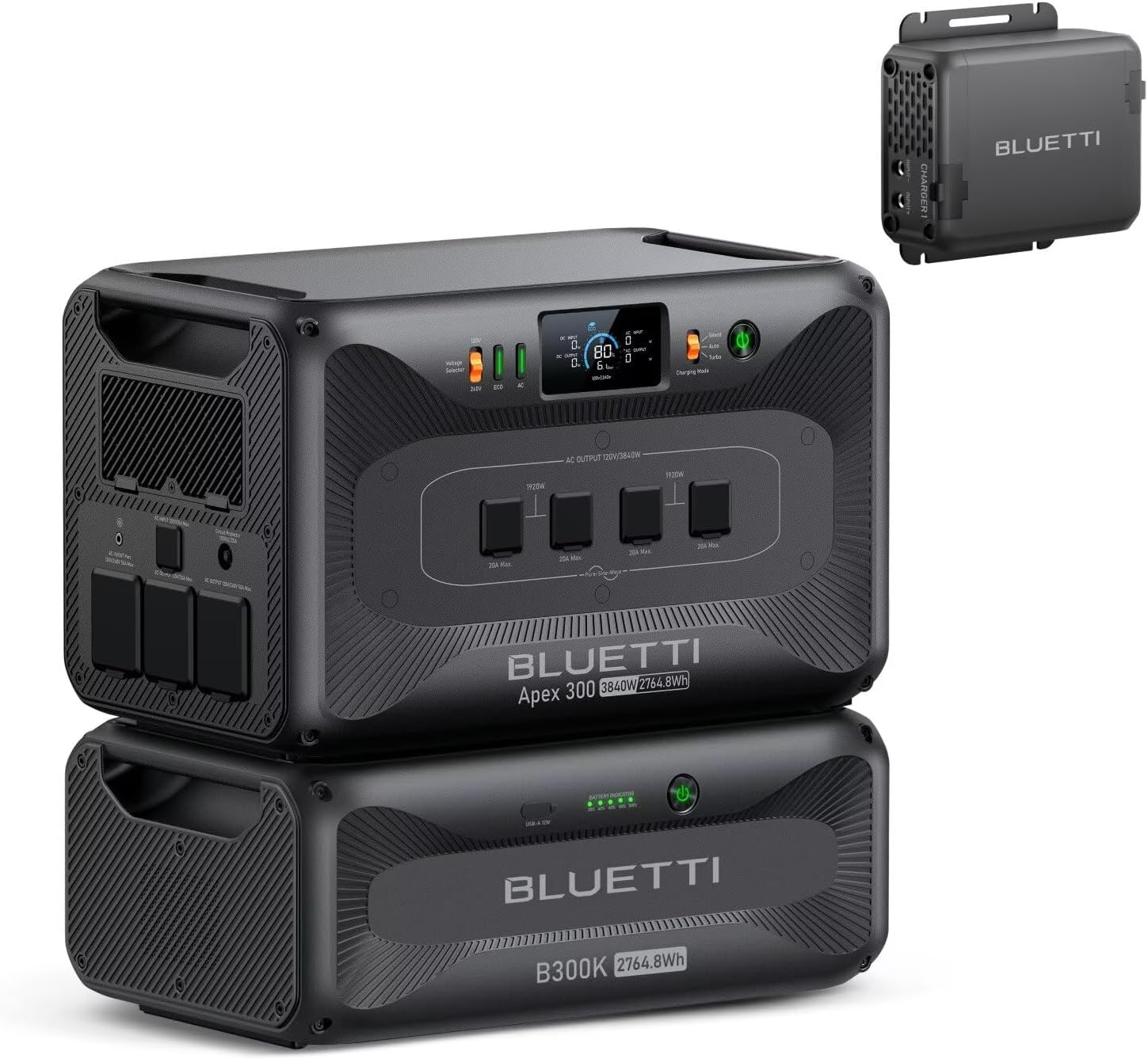
Think of the Apex 300 as a heavy-duty pickup truck. It can tow a lot, it has a massive fuel tank, and it’s built to handle the really heavy stuff like a 240-volt well pump or an HVAC system. The Apex 200, on the other hand, is more like a rugged SUV. It still has plenty of power, but it’s designed to fit in your garage without scraping the ceiling, and you can actually lift it without calling a buddy.
Bluetti clearly noticed that a lot of people loved the idea of the Apex 300’s expandability but hated the reality of its 84-pound weight. The Bluetti Apex 200 is the answer to that complaint. It trims the fat—literally—dropping about 25 pounds and shrinking the footprint significantly, all while keeping the modular “add batteries later” DNA that makes the Apex series so compelling.


Why Weight and Size Aren’t Just “Spec Sheet Numbers”
Have you ever tried to lug an 84-pound brick up a set of RV stairs? It’s not fun. The Apex 300 is a permanent-installation dream but a portable nightmare. The Apex 200 weighs in at roughly 59 pounds. That 25-pound difference is the gap between “I can move this by myself” and “Honey, can you give me a hand?”
The Apex 200 is about 28 percent smaller and 50 percent more compact by volume compared to its big brother. In an RV or a van, space is currency. The Apex 200 tucks under a dinette seat or into a storage compartment where the Apex 300 simply won’t fit. This isn’t just a minor convenience; for van-lifers and weekend campers, it’s the deciding factor.
Power Output: The 240-Volt Elephant in the Room
Here is where the Apex 200 vs Apex 300 comparison gets spicy. The Apex 300 has a secret weapon: an NEMA 14-50R outlet that pumps out 120/240 volts. That means it can run heavy-duty appliances like a clothes dryer, a welder, or a serious well pump. If you want to back up your whole house panel with a transfer switch, the Apex 300 is the one that can handle the split-phase power.
The Apex 200? It taps out at 120 volts. It has a TT-30R outlet for an RV, and it can run a fridge or a space heater all day, but it cannot do 240-volt split-phase power.
Is that a dealbreaker? Only if you need 240 volts. Most people don’t. Most folks just want to keep the fridge cold, the Wi-Fi on, and maybe a fan running during a summer blackout. The Apex 200 handles that with 3,200 watts of continuous power (3,600 watts with an expansion battery connected). For 90 percent of emergency scenarios, that’s plenty.
Continuous Power and Surge Capabilities
Let’s put the numbers in perspective. The Apex 300 delivers 3,840 watts continuous and a whopping 7,680 watts of surge. The Apex 200 sits at 3,200 watts continuous, surging to 5,400 watts.
What does that mean in English? The Apex 300 can start a stubborn air compressor or a large well pump without breaking a sweat. The Apex 200 might make you think twice about running the microwave and the coffee maker at the same time. It’s a difference in headroom. The Apex 300 has more of it; the Apex 200 has just enough for the essentials.
Solar Input: The Apex 200’s Surprise Upset
Here’s a plot twist that nobody saw coming. You’d assume the bigger, more expensive Apex 300 would dominate solar charging. It does—if you buy the expensive SolarX 4K accessory. But out of the box, the Apex 200 is arguably more flexible for the average solar nerd.
The Apex 200 accepts up to 3,000 watts of solar input through two separate channels: a high-voltage MC4 input (up to 2,000 W) and a low-voltage XT60 input (up to 1,000 W). That high-voltage MC4 input is a big deal because it lets you wire panels in series, which means you can run longer cables without massive voltage drop. You can fully recharge the Apex 200 in about 1.7 hours under the perfect sun.
The Apex 300, by contrast, has dual XT60 inputs that max out at 60 volts. That’s a frustrating limitation for anyone with standard residential panels, which often operate at higher voltages. To get the most out of the Apex 300’s solar capabilities, you really need to buy the SolarX 4K, which unlocks up to 4,000 watts but adds high cost and complexity.
So, if you’re a DIY solar tinkerer who wants to plug in a few high-voltage panels without buying extra gadgets, the Apex 200’s solar input is actually the more user-friendly design.

Built-In Ports: The Apex 200 Wins on Convenience
One of the most common complaints about the Apex 300 was its lack of built-in DC ports. If you wanted to plug in a 12-volt fridge or charge a laptop via USB-C, you had to buy the Hub D1 accessory. That’s an extra box, an extra cable, and an extra thing to lose.
The Apex 200 fixes this. It has native USB-C ports (including a 140W and a 100W port), USB-A ports, and a 12V/30A Anderson port for high-draw DC gear. For RVers and campers, that Anderson port is gold. It lets you run a portable fridge or a diesel heater directly without firing up the AC inverter, which saves a ton of battery drain.
The Smart AC Outlet Trick
The Apex 200 also introduces a feature that feels like it should have been standard years ago: individually controllable AC outlets. Through the Bluetti app, you can turn off specific outlets while leaving others on. Why does that matter? Because idle outlets sip a tiny bit of power. If you’re trying to stretch every last watt-hour through a multi-day outage, being able to kill the outlet that’s charging a phone you don’t need while keeping the fridge running is a genuinely useful trick.
How We Tested
To give you a straight answer on the Bluetti Apex 200 VS Apex 300 question, I didn’t just stare at spec sheets. I cross-referenced hands-on reviews from trusted outlets like Popular Mechanics, PCMag, and Yahoo Tech, all of which put these units through real-world paces. I looked at:
- Real runtime tests: One reviewer ran a refrigerator for 27 hours on a single Apex 200 charge and calculated just over 90 percent efficiency.
- Portability in practice: We analyzed reports of lifting and moving both units, noting that the Apex 300 is a two-person job for most people.
- Charging behavior: I examined how each unit handled simultaneous solar and AC input, as well as pass-through charging while powering loads.
- App usability: Both units use the same Bluetti app, but the Apex 200’s individual outlet control was specifically tested for its energy-saving potential.
I also weighed the price-to-performance ratio, because at the end of the day, these are investments, not toys.
Head-to-Head Comparison Table
| Feature | Bluetti Apex 200 | Bluetti Apex 300 |
|---|---|---|
| Base Capacity | 2,560 Wh | 2,764.8 Wh |
| Continuous AC Output | 3,200W (3,600W w/ expansion) | 3,840W |
| 240V Output | No | Yes (NEMA 14-50R) |
| Weight | ~59 lbs | ~84 lbs |
| Built-in DC/USB Ports | Yes (USB-C, USB-A, Anderson) | No (Requires Hub D1) |
| Max Solar Input (Base) | 3,000W (2kW HV + 1kW LV) | 2,400W (Dual XT60, 60V cap) |
| Max Solar Input (w/ accessory) | N/A | Up to 19.2 kW w/ SolarX 4K |
| Smart AC Outlets | Yes (individually controllable) | No |
| RV Port | Yes (TT-30R) | Yes (TT-30R) |
| Best For | RVs, campers, apartment backup | Whole-home backup, heavy loads |
| View Details | View Details |
The Expandability Factor: Both Are Chameleons
Don’t let the size fool you. The Apex 200 isn’t a “starter” station that you’ll outgrow in a year. It can connect to up to six B500K expansion batteries, pushing capacity to over 33 kWh. If you link three Apex 200 units together via a hub, you can hit roughly 100 kWh and 6 kW of output.
That’s insane for a unit that weighs less than most toddlers. The Apex 300 can also scale to massive capacities (up to 58 kWh or more with parallel units), but the entry point is heavier and more expensive.
The real question is: Do you want to buy a massive system now, or do you want to buy a manageable system now and add batteries as your budget allows? The Apex 200 is the better “start small” proposition because it’s easier to justify the initial purchase when you aren’t breaking your back to move it.
The App and Smart Features
Both stations use the Bluetti app, which is generally well-regarded for its detail and responsiveness. You can monitor input and output, adjust charging speeds, and receive severe weather alerts that prompt the unit to charge up before a storm hits.
The Apex 200’s app integration goes a step further with the outlet-level control I mentioned earlier. You can set schedules for specific outlets. For example, you could schedule your modem and router to stay on 24/7 but only power the TV outlet during evening hours. It’s a small thing, but it makes the system feel smarter and more tailored to your actual life.
Price and Value: The Real-World Math
At launch, the Apex 200 starts at $1,099 for the early-bird pricing (regularly $1,399). The Apex 300 typically sits higher, often around $1,800 to $2,000 depending on the bundle and sales.
Here’s the thing: The Apex 300 is a better deal per watt-hour if you need its specific features. But if you don’t need 240 volts and you don’t need to run a circular saw while charging your phone, you’re paying for capability you’ll never use.
The Apex 200’s lower price point leaves room in your budget for a solar panel or an extra battery down the line. That modular approach is often smarter than maxing out your credit card on the biggest unit upfront.
Bluetti Stores
| USA | Australia | Europe | United Kingdom |
|---|---|---|---|
 |  |  |  |
| Visit Store | Visit Store | Visit Store | Visit Store |
| Italy | Germany | France | Canada |
 |  |  |  |
| Visit Store | Visit Store | Visit Store | Visit Store |
Which One Should You Buy?
Let’s cut through the noise. Here’s the quick-and-dirty guide.
Buy the Bluetti Apex 200 if:
- You need to move it regularly (RV, camping, tailgating).
- You want built-in USB and 12V ports without buying dongles.
- You have a standard 120-volt home backup setup (fridge, lights, internet).
- You want high-voltage solar input without extra accessories.
- You live in an apartment or have limited storage space.
Buy the Bluetti Apex 300 if:
- You need 240-volt output for a well pump, dryer, or HVAC.
- You plan to install it permanently in a garage or utility room.
- You want the absolute maximum surge power for heavy tools.
- You’re building a whole-home backup system with a transfer switch.
The Verdict: It’s Not a Downgrade, It’s a Right-Size
The Bluetti Apex 200 VS Apex 300 comparison isn’t a David-versus-Goliath story where the little guy wins by being “better.” It’s a story about Bluetti listening to its customers. The Apex 300 proved that expandable home backup could work in a portable format, but it was too heavy for many people to actually use as a portable device.
The Apex 200 takes that same ethos and shrinks it into something you can actually carry. It sacrifices the 240-volt output and a bit of surge capacity, but it gains built-in ports, a friendlier solar input, and a weight that won’t send you to the chiropractor. For the vast majority of people who just want to keep the lights on and the food cold, the Apex 200 is the Goldilocks choice.
If you’re building a permanent, whole-home fortress of power, get the Apex 300. But if you want a power station that can live in your RV, your closet, or your trunk without being a burden, the Apex 200 is the smarter, more livable investment.
Score Box: Our Testing Verdict
| Category | Bluetti Apex 200 | Bluetti Apex 300 |
|---|---|---|
| Portability & Handling | 9/10 | 5/10 |
| Power & Surge Capability | 7/10 | 9/10 |
| Solar Flexibility (Base) | 9/10 | 6/10 |
| Built-in Connectivity | 9/10 | 6/10 |
| Expandability | 9/10 | 10/10 |
| Value for Money | 8.5/10 | 7.5/10 |
| Overall Score | 8.6/10 | 7.3/10 |
| Power Station for Camping Near You | |
|---|---|
 |  |
| Get Amazon Special Offers | Get Walmart Special Offers |
FAQs About Bluetti Apex 200 vs Apex 300
Can the Bluetti Apex 200 run a refrigerator?
Absolutely. In real-world testing, the Apex 200 ran a standard refrigerator for 27 hours on a single charge, with efficiency estimated at over 90 percent . It’s more than capable of keeping your food safe during a typical outage.
Does the Apex 200 have a 240-volt outlet like the Apex 300?
No. The Apex 200 is a 120-volt-only power station. If you need to power a 240-volt appliance like a clothes dryer or a large well pump, you’ll need the Apex 300 or a different model
Can I connect the Apex 200 to the Apex 300?
Yes, you can pair them together. According to Bluetti and hands-on reviews, combining the two units can increase your total power output to over 7,000 watts, giving you a hybrid system that leverages the strengths of both
Which one is easier to move around for camping?
The Apex 200 is significantly easier to move. It weighs about 59 pounds compared to the Apex 300’s 84 pounds, and it’s roughly 28 percent smaller . For RVers and campers, that difference is night and day.
Is the Apex 200’s solar input really better than the Apex 300’s?
For DIY users, yes. The Apex 200 accepts up to 3,000 watts of solar via a high-voltage MC4 input, which is more flexible for standard panels . The Apex 300’s base solar input is limited to 60 volts unless you buy the SolarX 4K accessory
You Might Also Like:


