| 10 People Are Viewing This Product Right Now |
Best Dual-Fuel Generators of 2026: 6 Top Picks for Home Backup, RVs, and Camping
There are dozens of models, and the spec sheets all shout the same big numbers. So we did the sorting. Below you’ll find six dual-fuel generators worth your money, a plain-English buying guide, and honest notes on what each one does badly.
Why a Dual-Fuel Generator Beats a Gas-Only Unit in an Outage
Best Dual-Fuel Generators – Think of a dual-fuel generator as a car with two fuel tanks and a switch on the dash. Gasoline is easy to find, right up until the pumps lose power. It also goes stale within a few months unless you treat it. Propane, on the other hand, keeps almost indefinitely in a sealed cylinder, which makes it the ideal emergency fuel. A dual-fuel portable generator lets you use whichever one you have, and that flexibility is the real selling point.
There’s a catch, and we won’t hide it. Propane typically delivers somewhat less output than gasoline, often around 10 percent less, so a generator rated for 7,500 watts on gas will give you a bit less on propane; for most households, that gap barely matters. For a tight power budget, it’s worth knowing before you buy.
Dual-Fuel Generator vs. Gas Generator: The Short Version
A gas generator is cheaper and simpler, but it leaves you hostage to the pump and the fuel’s shelf life. A propane and gas generator costs a little more up front, then pays you back in options. If you’ve ever stood in a gas line with a jerry can, you already know which one wins.


How We Tested (and Scored) These Dual-Fuel Generators
Fair question: how do you pick the best dual-fuel generator from a crowded field? We scored every model against one rubric, so no pick got a free pass. We worked from manufacturer spec sheets and owner manuals, studied a large pool of long-term owner feedback, and cross-checked our shortlist against what established gear-testing publications recommend. Each model earned a score out of 10 in five categories, weighted like this:
- Power output and fuel flexibility (30%): Running watts on gas and propane, surge capacity, and how well the machine handles real appliance loads.
- Reliability and build quality (25%): Engine type, warranty length, brand track record, and how owners say it holds up after years of use.
- Features (20%): Electric start, remote start, low-oil shutdown, carbon monoxide protection, outlet layout, and fuel-switching ease.
- Noise and portability (15%): Rated decibels, weight, wheel kits, and whether one person can move it.
- Value (10%): What you get for the money, including how much is missing from the box.
We also asked a practical question of every model: would we trust it to run a fridge, a furnace blower, and a few lights through a long winter night? If the answer was a shaky maybe, it didn’t make the list.
Best Dual-Fuel Generators at a Glance
Short on time? This table puts our top dual-fuel generators side by side. Wattages are approximate gas ratings, and propane output runs a little lower, so always confirm against the manufacturer’s current spec sheet.
| Pick | Category | Approx. running watts (gas) | Best for |
|---|---|---|---|
| Westinghouse WGen9500DF | Best overall | 9,500 | Whole-home backup with a transfer switch |
| Sportsman GEN7500DF | Best mid-size | 6,000 | Budget-minded home backup |
| DuroMax XP15000EH | Best heavy-duty | 12,000 | Large homes, workshops, job sites |
| Westinghouse iGen4500DF | Best quiet inverter | 3,700 | Camping, tailgating, light home use |
| Champion 3800-watt RV-ready | Best for RVs | 3,100 | Campgrounds and RV electronics |
| Pulsar 2200-watt inverter | Best lightweight | 1,800 | Tent camping and small loads |
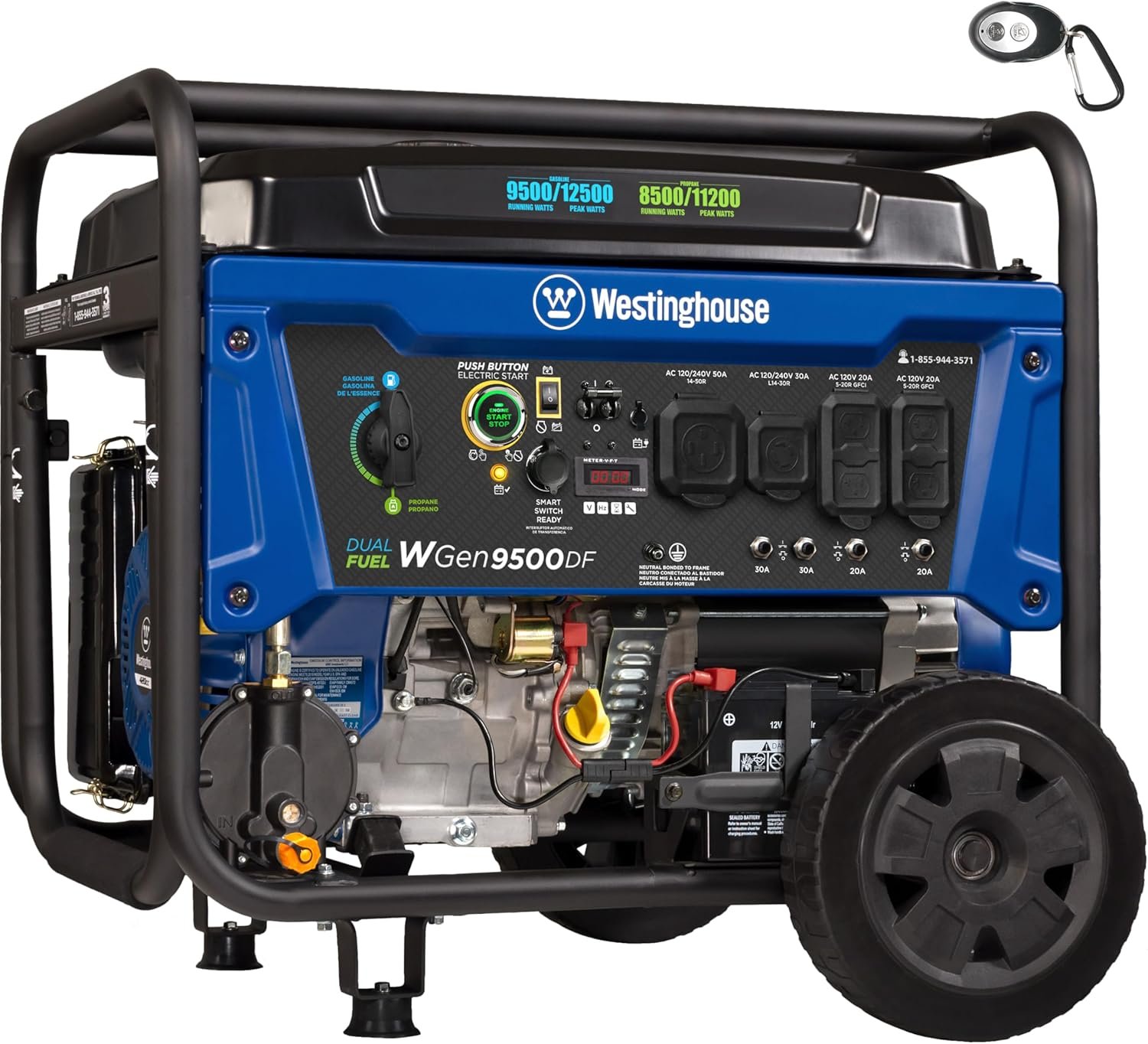
Best Overall Dual-Fuel Generator: Westinghouse WGen9500DF
Why It Earns the Top Spot

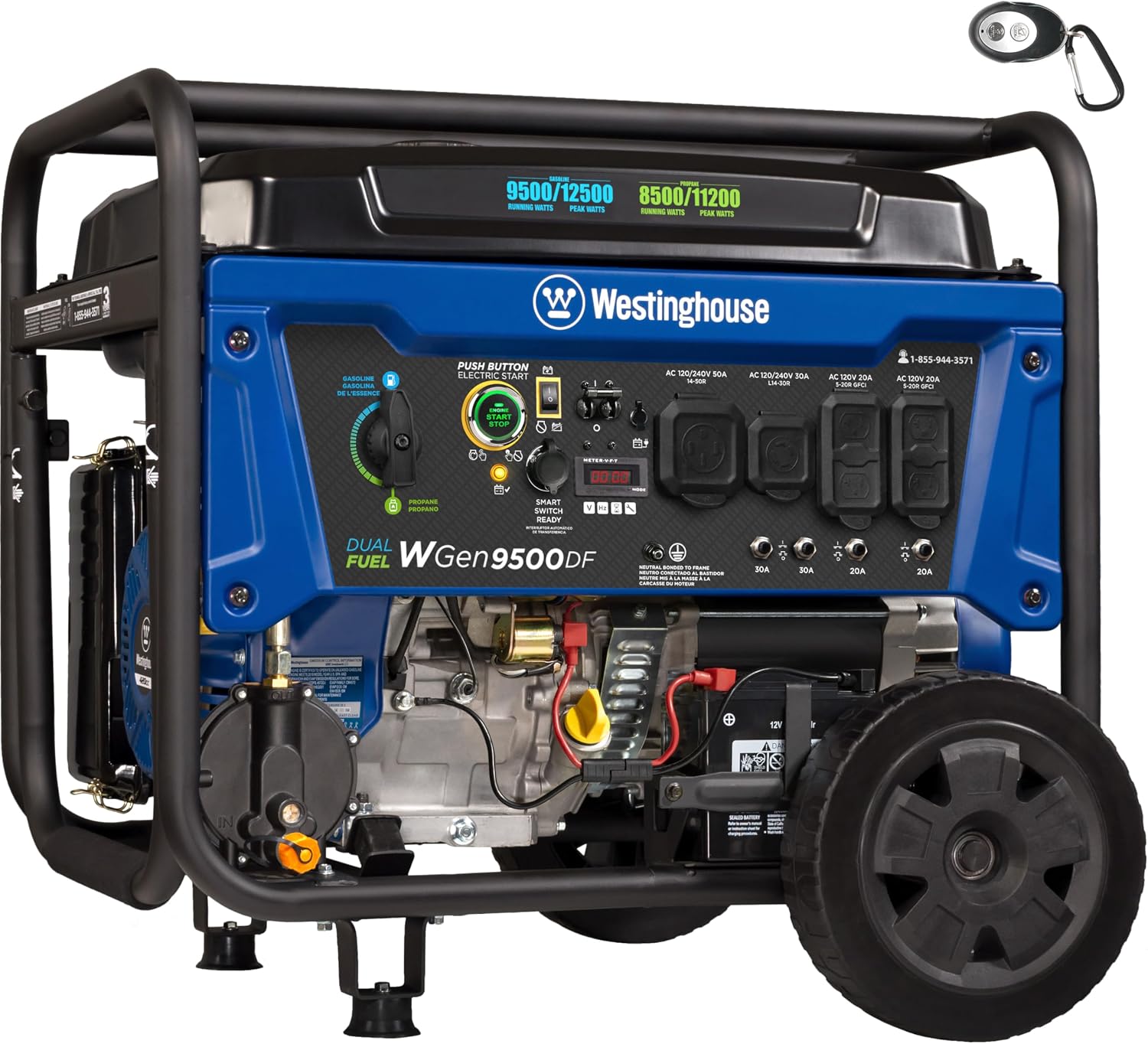
If you want one dual-fuel generator that can do almost everything, this is it. Rated around 9,500 running watts on gasoline, it has the muscle to run a fridge, a well pump, a furnace fan, and a window AC at the same time. Electric start and a remote key fob mean you can fire it up from the couch when the weather is nasty. Several of the roundups we reviewed also crown it their top pick, and it’s easy to see why: big power, sensible features, and a price that doesn’t make you wince.
What Could Be Better
It weighs roughly 211 pounds, so you’ll want to leave it on its wheels. And like any engine this size, it’s loud. Treat it like a lawn tractor, not a laptop.
Best Heavy-Duty Dual-Fuel Generator: DuroMax XP15000EH
Power to Spare
Some homes need more than a mid-size machine. Maybe you run a well pump, a big AC, an electric range, and a workshop. The DuroMax XP15000EH is built for that kind of load, with around 12,000 running watts and an electric start. Think of it as the pickup truck of the best dual-fuel generators: not subtle, but it hauls.
The Trade-Offs
It’s heavy, and it’s loud, and neither is a surprise at this size. You’ll also burn through fuel faster, so plan your propane supply carefully. Unless you truly need the capacity, a smaller unit will be kinder to your wallet and your ears.
Best Mid-Size Dual-Fuel Generator for Home Backup: Sportsman GEN7500DF
A Sweet Spot for Most Households
Here’s the quiet hero for homeowners who don’t want to overspend. The Sportsman GEN7500DF offers 7,500 starting watts, about 6,000 running watts, and a 13-horsepower engine. That’s plenty to keep the essentials alive: fridge, freezer, lights, internet, and a space heater. For many families, this is the best dual-fuel generator for home backup because it matches real needs without paying for capacity you’ll never touch.
Where It Falls Short
Owners tend to praise the value more than the polish. Expect a no-frills experience, so read the manual closely and check the outlet protections before you plug in sensitive electronics.
Best Dual-Fuel Inverter Generator for Quiet Power: Westinghouse iGen4500DF
Clean, Quiet, and Camp-Friendly
Inverter technology changes the game. Instead of spinning at one fixed speed, the engine adjusts to the load, which means less noise and less fuel. The iGen4500DF is a quiet dual-fuel generator in the 3,700-running-watt class, and its output is clean enough for laptops, phones, and CPAP-style electronics. Several expert roundups call it their best portable dual-fuel pick, and we agree: it’s the one you’ll actually enjoy carrying out of the garage.
Watch the Budget
You pay a premium per watt for that quiet. If you only care about raw power per dollar, an open-frame model will beat it. But if neighbors, campsite rules, or sleep matter, the extra cost buys real peace.

Best Dual-Fuel Generator for RV Owners: Champion 3800-Watt RV-Ready
Built for the Campground
RVers need a very specific recipe: enough juice for an air conditioner, a manageable size, and a socket that fits the rig. Champion’s 3,800-watt dual-fuel RV-ready generator checks those boxes. It’s a dual-fuel generator for RV trips that won’t dominate your storage bay, and the brand’s reputation for approachable features and wide dealer support counts for a lot when you’re far from home.
Keep an Eye on Load
Running a rooftop AC on propane can push the limits of a unit this size, so soft-start devices help. Check your RV’s power draw first, then match the generator, not the other way around.
Best Lightweight Dual-Fuel Generator: Pulsar 2200-Watt Inverter
Small, Light, and Surprisingly Capable
Not everyone needs to power a house. If you just want lights, phone chargers, a camp stove fan, and maybe a small cooler, the Pulsar 2200-watt dual-fuel inverter generator keeps things simple. At this size, you can lift it with one hand, tuck it in a trunk, and still have gas or propane options. It’s the most budget-friendly entry on our list of the best dual-fuel generators.
Know Its Limits
It won’t run a well pump or a big AC, and it isn’t meant to. Buy it for what it is: a pocket-sized backup for small loads.
How to Choose the Best Dual-Fuel Generator for Your Home
Buying a generator is a bit like buying shoes. The fanciest pair is useless if it doesn’t fit. Work through these five checks, and you’ll land on the right dual-fuel generator without second-guessing.
Start With Your Wattage Needs
Add up what you must run at once. A fridge might need 700 watts at startup, a furnace blower several hundred, and lights and chargers a little more. Then leave a buffer of 20 to 25 percent. Many households land between 3,500 and 7,500 running watts. Go much bigger, and you’re just buying fuel-hungry metal.
Check Propane Run Time, Not Just Gas
Manufacturers love quoting gasoline run times. Ask what you’ll really get from a 20-pound propane cylinder at half load. The honest answer varies by engine size, but it often lands in the range of a few hours up to roughly half a day. If you expect a multi-day outage, plan to stockpile cylinders or consider a larger tank.
Pick the Right Start System
A dual-fuel generator with electric start is worth every dollar when your hands are cold, and the power is out. Pull cords are fine for a camping unit, but at 3 a.m. in a blizzard you’ll want a button. Remote start is a bonus, not a requirement.
Consider Noise and Portability
Open-frame models are loud, often in the range of a running lawn mower. Inverter models are noticeably calmer. If you live close to neighbors or camp in busy parks, a quiet dual-fuel generator is worth the premium. Also check the wheel kit, because moving 200 pounds across gravel is no joke.
Plan Your Connection Method
Extension cords work for a few items. For hardwired circuits like a furnace or well pump, have a licensed electrician install a transfer switch or interlock kit. It keeps your power from feeding back into the grid, which protects line workers and your home.
Dual-Fuel vs. Tri-Fuel vs. Solar Generators
Still torn? Here’s a quick way to think about it. A dual-fuel model runs on gasoline and propane. A tri-fuel model adds natural gas, which can be great if you have a hookup but needs more setup. A solar generator, meaning a battery station with panels, is silent and fume-free, but its capacity and recharge speed are far lower than what a gas engine delivers.
Many careful households pair a big dual-fuel generator for outages with a small battery station for quiet, indoor-safe charging. It’s the belt-and-suspenders approach.

Gasoline vs. Propane: Which Fuel Should You Run?
Use gasoline when you need maximum output and have fresh fuel. Use propane for storage, safety, and convenience, since it burns cleaner and doesn’t gum up the carburetor. For long-term emergency readiness, many owners keep propane as the main backup fuel and gasoline as a secondary option.
Whatever you choose, follow the manual for switching between fuels, and don’t be surprised when the manual tells you to run the carburetor dry before changing over. That small ritual prevents hard starts later.
Safety Rules for Running a Dual-Fuel Generator
Carbon monoxide is the silent danger here, and it’s the reason safety agencies repeat the same advice every storm season. Never run any generator inside a garage, basement, or enclosed space, even with the door open. Keep it well away from windows, doors, and vents, and point the exhaust away from the house.
Install battery-powered or battery-backup CO alarms inside your home. Let the engine cool before refueling, store gasoline in approved containers, and keep propane cylinders upright and outdoors. If the unit comes with a CO shutoff feature, treat it as a backup, not a license to cut corners.
Maintenance Tips to Keep Your Dual-Fuel Generator Reliable
A generator that fails on day one of an outage isn’t a backup; it’s a paperweight. Fortunately, upkeep is simple. Run it under load for about 15 to 20 minutes every month. Change the oil on the schedule in your manual, starting with the break-in change. Swap the spark plug and air filter regularly, and keep the battery charged if you have electric start.
Between uses, either use fuel stabilizer in the gas or run the tank dry, and store propane hooked up only when needed. Ten minutes of care beats ten hours of cursing in the dark.
Conclusion: Which Dual-Fuel Generator Should You Buy?
So, what’s the best dual-fuel generator for you? If you want one machine that covers an entire house, the Westinghouse WGen9500DF is the safest bet. Need lots more capacity? The DuroMax XP15000EH delivers. Watching the budget? The Sportsman GEN7500DF gives mid-size power at a friendly price.
For quiet camping and tailgating, grab the Westinghouse iGen4500DF, and for RV trips, the Champion 3800-watt is a smart match. Just need a little light and phone charging? The Pulsar 2200 is your pocket-sized backup. Whichever you pick, size it to your real loads, store your fuel wisely, and test it before the storm hits. Power outages are never convenient, but being ready can be.
Final Score Box: Our Dual-Fuel Generator Ratings
Scores are out of 10, weighted by the rubric in the testing section above (power 30%, reliability 25%, features 20%, noise and portability 15%, value 10%).
| Model | Power | Reliability | Features | Noise and portability | Value | Overall |
|---|---|---|---|---|---|---|
| Westinghouse WGen9500DF | 9.5 | 8.5 | 9.5 | 5.5 | 8.5 | 8.6 |
| DuroMax XP15000EH | 10 | 8.0 | 8.5 | 4.5 | 8.0 | 8.2 |
| Westinghouse iGen4500DF | 7.0 | 8.5 | 9.0 | 9.0 | 7.5 | 8.1 |
| Champion 3800-watt RV-ready | 7.0 | 8.5 | 8.0 | 8.0 | 8.0 | 7.8 |
| Sportsman GEN7500DF | 8.5 | 7.5 | 7.5 | 5.5 | 9.0 | 7.7 |
| Pulsar 2200-watt inverter | 5.5 | 7.0 | 7.0 | 9.0 | 8.5 | 7.0 |
FAQs About Dual-Fuel Generators
Is a dual-fuel generator worth the extra money over a gas generator?
For most people, yes. The price gap is usually modest, and the payoff is real: you can run on propane when gasoline is scarce or old. If you only plan to use a generator occasionally, that fuel flexibility is a cheap insurance policy.
How long will a dual-fuel generator run on a 20-pound propane tank?
It depends on the generator size and the load. Small inverter models can run many hours, while larger units at heavy load may burn through a cylinder in just a few hours. Check the manufacturer's propane run-time chart and plan your cylinder supply from that figure.
Can I switch between gasoline and propane while the generator is running?
Some models allow a switch-and-go change, but many want you to shut down, disconnect one fuel source, and run the carburetor dry before changing. Follow your model's manual, because the safe procedure differs between brands.
Can I plug a dual-fuel generator directly into my house?
Not with a homemade cord. Backfeeding through an outlet is dangerous and illegal in many places. Hire a licensed electrician to install a transfer switch or interlock kit, or just run extension cords to individual appliances.
What size dual-fuel generator do I need to run my fridge, furnace, and lights?
Most homes can cover those essentials with roughly 3,500 to 6,000 running watts. Add up your starting and running watts, then leave a safety buffer. If you want to add an AC or a well pump, step up to a 7,500-watt-plus unit.
| Traditional Generator Collections Near Me | |
|---|---|
 |  |
| Check Discount | Check Discount |
You Might Also Like: