| 10 People Are Viewing This Product Right Now |
EcoFlow RIVER 260 Gen4 Review: Is This 3 kg Power Station Worth Your Money?
It’s a tiny 256Wh portable power station built for weekend trips, desk-side backup and light travel. It won’t run a space heater. It won’t power your whole camper. It isn’t trying to. If you want something you can toss in a backpack, though, keep reading.
What Is the EcoFlow RIVER 260 Gen4?
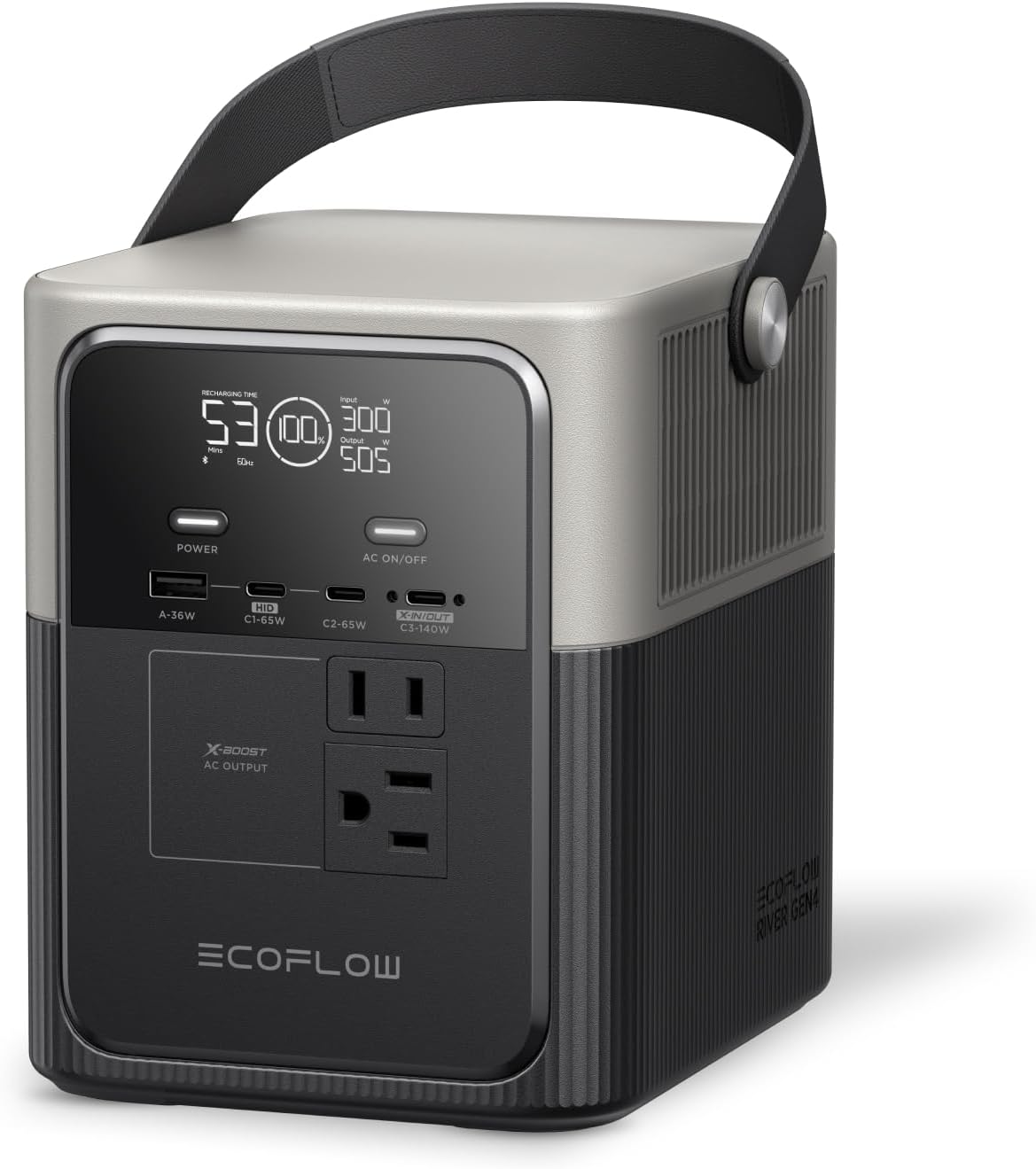
EcoFlow RIVER 260 Gen4 Review: The RIVER 260 Gen4 is the entry-level model in EcoFlow’s fourth-generation RIVER line. It packs a 256Wh battery and 300W of continuous AC output, and X-Boost can stretch that to 600W for compatible devices. Think of it as the little sibling who shows up to every trip and never complains about space.
The big story is size. EcoFlow says it’s roughly 29.7 per cent smaller and 16.9 per cent lighter than the RIVER 3 at comparable capacity. Those are manufacturer numbers, so treat them as claims until independent testers confirm them. Even so, the direction is clear: EcoFlow wants this to be the power station you actually remember to pack.


How We Tested (and What That Means for This Review)
I want to be upfront here, because trust matters more than hype. The RIVER 260 Gen4 is brand new, and I have not run my own bench tests on it yet. So this review is built differently from a typical hands-on test.
Here’s what I did instead:
- Cross-checked specs from EcoFlow’s official announcements, its European product page, and several independent tech outlets that covered the launch.
- Separated claims from calculations. Anything labeled “EcoFlow says” is the manufacturer’s number. Anything labeled “my estimate” is my own watt-hour math, using a realistic 85% inverter efficiency.
- Stress-tested the marketing against physics. A 256 Wh battery is a 256 Wh battery. No spec sheet changes that, so I ran every runtime claim through that lens.
When a unit lands on my desk, here’s what I’ll measure: a wall-to-80% charge with a watt meter, real runtime on a laptop, a router, and a small fridge, fan noise with a decibel meter, surface temperature under load, and solar charging in actual sunlight. I’ll update the numbers and the score box when I have them. Fair deal?
EcoFlow RIVER 260 Gen4 Specs at a Glance
Here’s the RIVER 260 Gen4 specs sheet, pulled together from the sources above.
| Spec | EcoFlow RIVER 260 Gen4 |
|---|---|
| Battery capacity | 256 Wh (LFP chemistry) |
| AC output | 300W continuous, 600W with X-Boost |
| USB-C ports | 1 × 140W, 2 × 65W |
| USB-A port | 1 × 36W |
| Total outputs | 5 |
| Dimensions | 139 × 177 × 175 mm |
| Weight | About 3 kg (6.6 lb) |
| AC charging | 0–80% in 42 minutes (claimed) |
| Max solar input | 110W |
| Cycle life | 80% capacity after 4,000 cycles |
| Noise | About 30 dB (claimed) |
| UPS switchover | Under 10 ms |
Most of those numbers come from a launch-day report that lists the dimensions, the LFP cell, the port lineup, the 110W solar cap, and the 4,000-cycle rating. The five-output count is confirmed separately by EcoFlow’s IFA announcement.
Design and Portability: A Lunchbox That Powers a Laptop
Size and Weight
At roughly 3 kg, the RIVER 260 Gen4 sits in that sweet spot where you can carry it with one hand without thinking about it. The series also ships with removable carrying straps. Compare that to older 250Wh-class stations that feel like hauling a small toolbox, and the appeal is obvious.
Why does size matter so much? Because the best power station is the one that makes the trip. A 10 kg unit lives in the garage. A 3 kg unit lives in the passenger seat.
Ports and Outputs
For a compact unit, the port mix is smart. You get three USB-C ports (140W and two at 65W) plus one USB-A at 36W, along with the AC outlet. The 140W USB-C port is the star. It can power a modern laptop without going through the AC inverter, which saves energy. It also works in the other direction: the 140W USB-C port is bidirectional, so it can charge the station too.
My only gripe is on paper rather than in hand: a single AC outlet means you’ll likely reach for a power strip if you’re running more than one wall-plug device.

EcoFlow RIVER 260 Gen4 Review: Battery Capacity and Real-World Runtime
What Can a 256Wh Power Station Run?
Capacity is where small power stations get judged and where honest math beats marketing. A 256Wh pack gives you roughly 215Wh of usable energy after conversion losses. That’s my estimate, not a measured figure. Here’s what that looks like:
| Device | Typical draw | Estimated runtime |
|---|---|---|
| Smartphone (about 15 Wh battery) | n/a | 12–14 full charges |
| Laptop via USB-C | 60W | About 3.5 hours |
| Wi-Fi router via AC | 12W (plus inverter overhead) | 10–11 hours |
| Small camping fridge (cycling) | About 20W average | 8–10 hours |
| LED camp lights via USB | 10W | About 20 hours |
Those are rules of thumb, so your mileage will vary. One detail helps your cause: the series reportedly draws only about 6.6W when AC output is on and about 1W on standby, which means less energy wasted just sitting there. For comparison, a lot of older stations burned noticeably more idling.
EcoFlow also advertises a Fridge Runtime Boost mode. The company says it can stretch compressor-fridge runtime by around 15% under the right conditions. I’d call that a “nice if true” bonus rather than a reason to buy.
Power Output and X-Boost: How Much Muscle Does 300W Give You?
Three hundred watts is plenty for laptops, cameras, CPAP-class low-draw gear, lights, fans, routers, and small TVs. It’s not enough for kettles, hair dryers, microwaves, or anything with a heating element and a big appetite.
That’s where X-Boost comes in. It’s a clever trick: the station lets certain resistive devices run up to 600 W, but at reduced power. The tradeoff is that appliances run more slowly. Picture a small garden hose trying to fill a pool. It gets there, just not fast. A mini hot plate or a small heater might technically start, but don’t expect full performance.
If you regularly need 1,000W or more, the RIVER 260 Gen4 is the wrong tool. Skip ahead to the comparison below.
Charging Speed: The 42-Minute Claim
This is the headline feature. EcoFlow says X-Stream 4.0 with active thermal management takes the RIVER 260 Gen4 to 80 percent in 42 minutes. That’s roughly one coffee stop and a bathroom break.
A caveat I’d flag every single time: EcoFlow quotes the 0–80% number, not 0–100%. Batteries slow down near the top to protect their cells, so the last 20% will take longer. It’s the same reason your phone races to 80% and then crawls.
Solar Charging with the RIVER 260 Gen4
Solar input tops out at 110W, according to the launch coverage. In real sunlight, panels rarely deliver their rated wattage, so a 110W panel might feed you 70–90W on a good day. By my math, a full solar recharge from empty is a 3–4 hour job in strong sun. EcoFlow is also pushing a bundle: a version with a portable 60W solar panel listed at 299 euros, against 348 euros when bought separately. A 60W panel will be slower, probably 5–6 hours for a full charge, but for weekend camping it’s a sensible pairing.
Car and USB-C Charging
You’ve also got flexibility on the road. The station supports charging from AC, USB-C, solar, and a vehicle. That means a long drive can top you up before you’ve even set up camp.

Smart Features: UPS, Emergency Power Mode, and Fridge Runtime Boost
Small power stations used to be dumb batteries. The RIVER 260 Gen4 is smarter than that, and a few features deserve a closer look.
- UPS mode. A 10 ms switchover keeps connected electronics running through power interruptions. Plug a desktop router or a small PC in, and a blip in the grid won’t reboot them. I wouldn’t rely on it for life-support equipment, though. Check with the device maker for that.
- Emergency Power Mode. This one made me smile. When the display hits 0%, the unit can tap a small reserve to give a phone a last-ditch boost, and EcoFlow’s own testing suggests enough for roughly 5–10% on a recent iPhone. It needs to be switched on in the app beforehand, and it doesn’t add real capacity. Think of it as the spare tire in your trunk: ignore it until the day you really need it.
Battery Chemistry, Lifespan, and Warranty
Inside is a lithium iron phosphate (LFP) battery, the safer and longer-lasting chemistry that’s become the standard for quality portable power. EcoFlow rates it to keep at least 80% of its capacity after 4,000 charge cycles. Even if you cycle it once a week, that’s a very long runway.
On the warranty side, EcoFlow lists three years in Europe, made up of two standard years plus one extra when you register via the app or website. Worth doing the five-minute registration on day one.
And noise? EcoFlow claims roughly 30 dB in operation, about library-whisper territory. I’ll verify that with a meter when I get hands-on, because fan noise at full load is the first thing a spec sheet tends to flatter.
EcoFlow RIVER 260 Gen4 vs RIVER 520 Gen4 vs RIVER 3
Which one fits your life? Here’s how the two new RIVER Gen4 models stack up.
| Feature | RIVER 260 Gen4 | RIVER 520 Gen4 |
|---|---|---|
| Capacity | 256 Wh | 512 Wh |
| AC output | 300W | 500W |
| X-Boost peak | 600W | 1,000W |
| Weight | About 3 kg | About 4.6 kg |
| 0–80% charge | 42 min | 50 min |
| Outputs | 5 | 6 |
| View Product | View Product |
Specs for the larger model come from EcoFlow’s IFA announcement of capacities, outputs, and weights, and the output counts from the same launch coverage. The 520 is also arriving later in most regions.
As for the RIVER 3, the predecessor, EcoFlow’s numbers say the new model is about 30% smaller and 17% lighter at a similar capacity. If you already own a RIVER 3 and mostly use it at home, I wouldn’t upgrade. If you’re hunting for a lighter travel companion, the RIVER 260 Gen4 is the more interesting machine.
RIVER 260 Gen4 Price and Value: Is It Worth It?
In Europe, the list price is 249 euros, with a launch promotion bringing it to 229 euros. In Germany, qualifying orders also get a free USB-C to 12V adapter and a solar angle guide. As I write this, I couldn’t confirm a US price, since the US presale only just opened, so check EcoFlow’s US page before you buy.
Run the numbers at the launch price, and you land near 0.89 euros per watt-hour, which is competitive for a premium-brand LFP unit in this size. You’re paying for portability, fast charging, and software, not raw capacity. If you only care about the cheapest watt-hour, a bigger, bulkier station will beat it. If you care about carrying it, this wins.
EcoFlow Stores
| United Kingdom | Italy | France | Spain | Germany | Canada | Australia | USA |
|---|---|---|---|---|---|---|---|
 |  |  |  |  |  |  |  |
| View Special Offers | View Special Offers | View Special Offers | View Special Offers | View Special Offers | View Special Offers | View Special Offers | View Special Offers |
Pros and Cons of the EcoFlow RIVER 260 Gen4
Pros
- Very small and light, about 3 kg
- Fast AC charging (0–80% in 42 minutes, claimed)
- LFP battery with a long cycle life
- 140W bidirectional USB-C port
- UPS mode and an Emergency Power Mode
- Low idle draw reported for the series
Cons
- Only 256Wh, so runtimes are short for anything power-hungry
- 300W AC cap, and X-Boost slows appliances down
- Single AC outlet
- Real-world performance is unverified until independent testing arrives
Who Should Buy the RIVER 260 Gen4 (and Who Should Skip It)
You’ll love it if you’re a camper who wants a light overnight setup, a remote worker who wants laptop backup, a traveler who likes keeping gadgets alive, or someone who wants a tiny UPS for a router and modem.
Skip it if you need to run a coffee maker, a space heater, or power tools, or if you want multi-day fridge backup for a household. For that, step up to the RIVER 520 Gen4 or a larger EcoFlow DELTA model.
Conclusion
EcoFlow RIVER 260 Gen4 Review: So, is the EcoFlow RIVER 260 Gen4 worth it? On paper, yes, for the right buyer. It trades raw capacity for portability, charges quickly, uses a durable LFP battery, and adds clever extras like UPS mode and an emergency phone reserve. It’s not the unit for big appliances, and I’d hold off declaring it perfect until independent tests confirm the 42-minute charge, the 30 dB noise figure, and the real-world runtimes.
If you want a pocketable-feeling power station for trips and light backup, this EcoFlow RIVER 260 Gen4 review points to a strong contender. Just match the 256Wh to your actual needs before you click buy.
Score Box: EcoFlow RIVER 260 Gen4 (Provisional)
Based on published specs and manufacturer claims, not on bench testing. Scores will be updated after hands-on testing.
| Category | Score (out of 10) |
|---|---|
| Portability | 9.5 |
| Charging speed | 9.0 |
| Features (UPS, Emergency Power Mode) | 8.5 |
| Value for money | 8.0 |
| Output power | 6.5 |
| Capacity and runtime | 6.0 |
| Overall (provisional) | 7.9 / 10 |
FAQs About EcoFlow RIVER 260 Gen4
How long does the RIVER 260 Gen4 take to charge fully?
EcoFlow quotes 0–80% in 42 minutes from a wall outlet. The company hasn't headlined a 0–100% time, and the last stretch usually slows to protect the battery, so plan for noticeably longer to hit full.
Can the RIVER 260 Gen4 run a mini fridge?
Usually yes, for a few hours. A small compressor fridge cycles on and off, so my estimate is 8–10 hours depending on the model and the room temperature. Starting surges matter, so check the fridge's rating against the 300W limit.
Can I charge the RIVER 260 Gen4 with solar panels?
Yes. Solar input is capped at 110W, and EcoFlow sells a bundle with a 60W portable panel in Europe. Expect a few hours in strong sun for a full recharge.
Can I take the RIVER 260 Gen4 on a plane?
Almost certainly not. Airlines generally limit spare lithium batteries to around 100Wh, or up to 160Wh with airline approval, and 256Wh is well beyond that. Check your airline's rules, but plan on driving or shipping it.
Is the RIVER 260 Gen4 worth upgrading to from a RIVER 3?
If you want something smaller and lighter, maybe. EcoFlow says it's about 30% smaller and 17% lighter at similar capacity. If you mostly use your RIVER 3 at home, the upgrade is hard to justify.
| Solar Generator Near You | |
|---|---|
 |  |
| Check Amazon discounts. | Check Walmart discounts. |
You Might Also Like: