| 10 People Are Viewing This Product Right Now |
Biggest Portable Generator for Home: 5 Powerhouses That Can Run Your Whole House (2026)
So you start searching for the biggest portable generator for home use. You want something that plugs into your house and keeps the whole place running, without paying for a permanent standby unit and the installation that comes with it.
Can the Largest Portable Generator for Home Really Power a Whole House?
Short answer: sometimes, with conditions.
Most portable generators can’t run an entire house. Portable generators for home use are designed to power important items like appliances and digital devices, and for more reliable backup power, a standby generator is the better call. That’s fair for typical 5,000-watt units. But the top tier plays a different game.
Bob Vila
Think of generators like pickup trucks. A compact one hauls groceries. A heavy-duty one hauls a trailer. The largest portable generators for home use sit in the 15,000 to 20,000 watt range, and at that size they can carry a whole house on their back, provided you’re smart about which loads run at the same time.
The Generac GP15500EFI and GP18000EFI are a good example. Generac describes them as large enough to potentially provide whole-home backup power when paired with a HomeLink manual transfer switch. Notice the word “potentially.” That’s the honest framing, and we’ll unpack it below.
How We Tested and Scored These Generators
Let’s be straight with each other. Nobody has a garage big enough to run five 400-pound generators back to back, and I won’t pretend otherwise. Here’s the method behind the scores instead.
We scored each unit on seven criteria:
- Running and starting wattage
- Fuel flexibility
- Outlet layout and transfer switch readiness
- Safety features such as carbon monoxide shutdown
- Power quality (total harmonic distortion)
- Runtime
- Value for the money
We pulled specs directly from manufacturer documentation and cross-checked them against independent lab and hands-on reviews. Consumer Reports’ approach was our model for thinking about real-world performance.
Their engineers load every model with essentials like a space heater, refrigerator, or window air conditioner, then check what happens when a sudden voltage spike hits, such as a refrigerator compressor kicking on near capacity. That surge scenario is exactly what matters during an outage, so we weighted starting watts heavily.
Prices move constantly, so treat the figures below as ballpark numbers and check the current listing before you buy.


Biggest Portable Generators for Home: Quick Comparison Table
| Model | Running Watts | Fuel Type | Best For | Approx. Score |
|---|---|---|---|---|
| Westinghouse WGen20000 | 20,000 (28,000 peak) | Gasoline | Maximum power, large homes | 9.2/10 |
| Generac GP18000EFI | 18,000 | Gasoline (EFI) | Brand trust, big AC loads | 9.0/10 |
| DuroMax XP16000iH | 16,000 max | Dual fuel (inverter) | Cleaner power, propane option | 8.7/10 |
| Generac GP15500EFI | 15,500 | Gasoline (EFI) | Lower price in the Generac line | 8.6/10 |
| DuroMax XP15000HXT | 15,000 classes | Tri fuel | Natural gas hookup | 8.5/10 |
Scores are editorial and based on research and specs, as explained above.
The 5 Biggest Portable Generators for Home in 2026
1. Westinghouse WGen20000: The Biggest Portable Generator for Home Backup
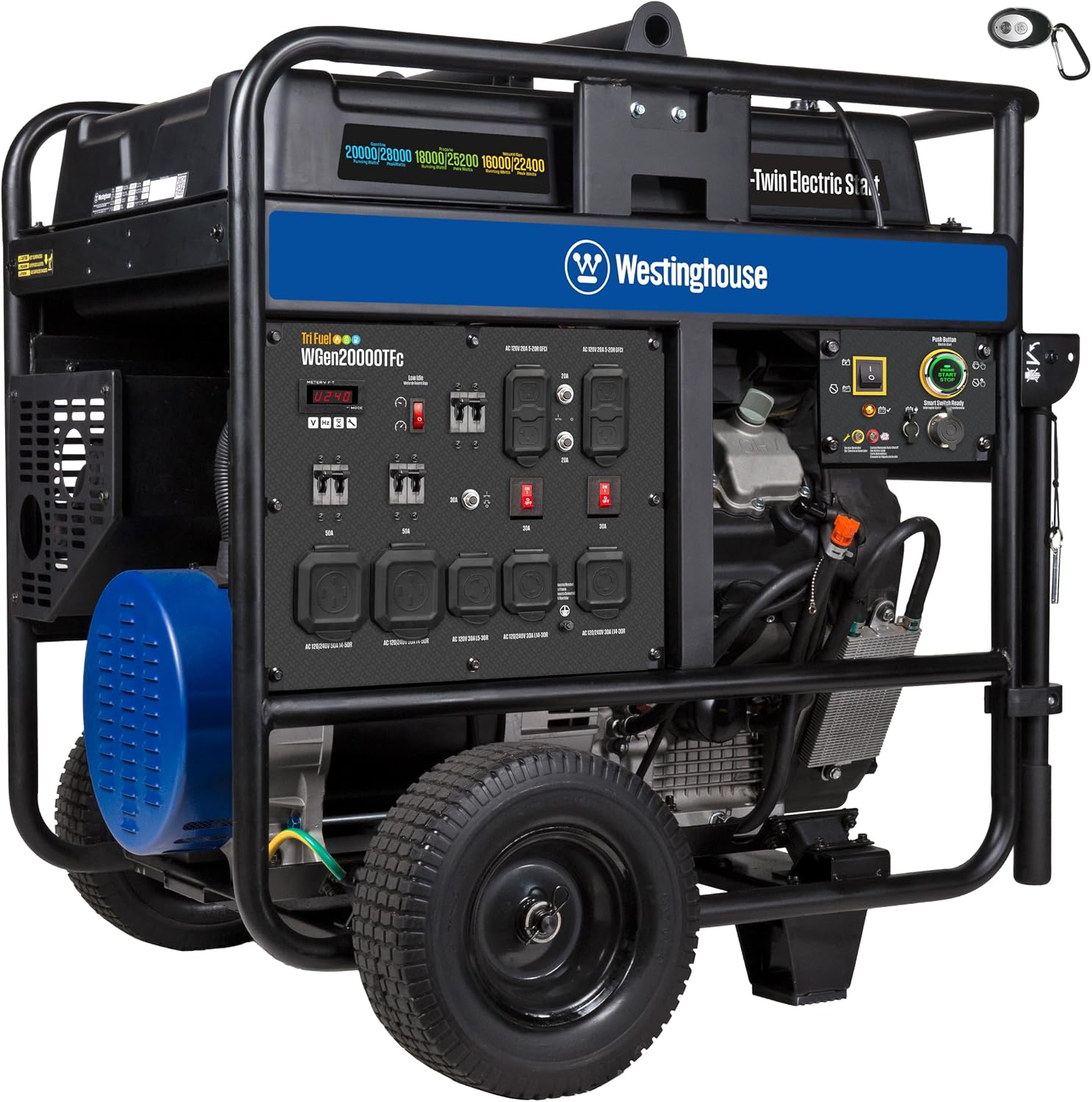
If raw wattage is your only goal, this is the one. The WGen20000 delivers 28,000 peak watts and 20,000 running watts, powered by a 999 cc V-Twin engine. That’s a lot of muscle.
The outlet panel is what sells it for house backup. It has four GFCI household outlets, two 50-amp outlets, two 30-amp outlets, and a 30-amp 120V outlet, all with rubber covers. Those big twist-lock and 50-amp receptacles are what you need to feed a transfer switch or interlock kit with a single cord.
Runtime is decent for a machine this size. Westinghouse quotes up to 17 hours at 25% load on a 17-gallon tank. Run it closer to half load, and you’ll get noticeably less, so plan your fuel accordingly.
The trade-off? It’s gasoline only, and it’s a beast to move. Budget for a good spot and a fuel storage plan. It also has a lower total harmonic distortion than you might fear, under 5% THD, which is safe for computers, phones, and TVs.
2. Generac GP18000EFI: The Largest Wattage From a Household Name
Generac has been in the backup power business forever, and this is their top portable. It provides 18,000 running watts and uses the G-FORCE 816CC EFI engine, built for fuel efficiency across load levels. Fuel injection matters here. It helps the engine sip fuel at lighter loads instead of guzzling like an old carbureted brute.
The headline capability is air conditioning. Generac says it’s powerful enough to start many 5-ton air conditioning units and can power up to 16 circuits. If your home relies on central air, that’s a huge deal.
Safety is baked in too. The COsense technology automatically shuts the unit down when toxic carbon monoxide levels are detected. At launch, the GP18000EFI carried an MSRP of $4,399. Check today’s price, since it may have shifted.
One note: Generac’s own residential page describes its largest portable as a 17,500-watt class unit, so confirm the exact rating of the specific SKU you’re buying. Ratings vary a little between listings.
3. DuroMax XP16000iH: The Biggest Dual Fuel Inverter Generator for Home
Inverters are the quiet, clean-power cousins of standard open-frame generators, and the XP16000iH is unusually large for the type. DuroMax calls it the largest portable dual-fuel inverter generator on the market, with a 16,000-watt maximum output.
The dual-fuel part is a genuine advantage in a long outage. Propane doesn’t go stale in a tank the way gasoline can. It also includes two 50 amp outlets and automatically shuts down when harmful fumes are detected.
Keep in mind that “16,000 max watts” is a peak figure. Running output is lower, so size your loads to the running number, not the headline. It’s the pick for people who value cleaner electricity and fuel flexibility over sheer maximum wattage.
4. Generac GP15500EFI: The Big Portable Generator for House Backup Without the Top-Tier Price
Not everyone needs 18,000 watts. Honestly, plenty of homes don’t. The GP15500EFI shares the same engine platform as its bigger sibling. It offers 15,500 running watts and launched at an MSRP of $3,999.
One reviewer roundup lists its specs as 15,500 running and 19,300 starting watts on gasoline, with a 14.2-gallon tank and about 11 hours of runtime at 50% load. The same review flags the downsides: it’s gasoline only, and at roughly 420 pounds it’s the heaviest unit on their list, so it needs a permanent spot.
If you’d rather spend a few hundred dollars less and still power most of a house, this is the sweet spot.
5. DuroMax XP15000HXT: A Tri-Fuel Whole House Portable Generator
Fuel flexibility is the story here. Being able to run on gasoline, propane, or natural gas means you’re never at the mercy of a single supply. During a regional outage when gas stations are dark or lined up for blocks, that’s real peace of mind.
One review noted that it held wattage under natural gas loads more reliably than many competing tri-fuel units, thanks to an included 3/4-inch hose that avoids a bottleneck. If you already have natural gas at your house, that detail matters a lot.
Another roundup pegs its running output near 12,000 watts, which is enough for a home of around 3,000 square feet with sensible load management. Bigger isn’t always better. Matching the generator to your actual house is what counts.

How Much Wattage Does a Big Home Generator Really Need?
This is where most people go wrong. They buy the biggest number they can afford, or the smallest one that “seems fine,” and neither approach is smart. Sizing a generator is like packing for a trip. You need to know what’s going in the bag first.
1. Running Watts vs. Starting Watts (and Why It Matters)
Running watts are what an appliance draws steadily. Starting watts are the short jolt motors need to get moving. A refrigerator compressor, well pump, or air conditioner can demand two to three times its running power for a second or two.
Imagine pushing a stalled car. Getting it rolling takes far more effort than keeping it rolling. Your generator has to handle that initial shove without bogging down or tripping.
2. A Simple Load Math Example
Here’s a ballpark exercise. These are typical figures, so check your own appliance labels:
- Refrigerator: about 700 running watts, 2,000+ to start
- Sump pump: about 800 running, more to start
- Furnace blower: about 800 running
- Lights, TV, Wi-Fi, and phone chargers: about 500 combined
- 3-ton central air conditioner: about 3,500 running, with a large starting surge
Add the running loads, and you’re around 6,300 watts. Add the biggest starting surge on top, and you can see why a 7,500-watt unit feels tight and a 12,000 to 15,000-watt unit feels comfortable. Once you add an electric range, dryer, or a second AC, that’s when the 18,000- to 20,000-watt machines earn their keep.
Gasoline, Dual Fuel, or Tri Fuel: Which Is Best for Large Portable Generators?
Fuel choice is a bigger decision than most buyers realize. Gasoline is easy to find on a normal day and gives you the most power per engine. But it goes stale in storage and disappears from stations during big disasters.
Dual fuel adds propane, which stores nearly forever. You lose a little output on propane, but you gain resilience.
Tri-fuel adds natural gas, which can flow from your utility line indefinitely, as long as that line stays live. It’s the closest thing a portable gets to a standby generator’s fuel independence.
If you live somewhere prone to multi-day outages, lean toward the multi-fuel machines even if the raw wattage is a bit lower.
Transfer Switches and Interlock Kits: How to Connect a Big Generator to Your House
Here’s a rule I’ll repeat until I’m blue in the face: never backfeed your house through a dryer outlet with a homemade “suicide cord.” It’s illegal in many places, and it can electrocute a utility worker fixing the lines.
The correct way to run a portable generator with a transfer switch is with either a manual transfer switch or an interlock kit, both installed by a licensed electrician. They isolate your house from the grid so power can only flow one direction.
That’s why the outlet layout matters. The 30-amp and 50-amp receptacles on these big units are what allow that clean, single-cord hookup to your panel. Skip this step, and you’re stuck running extension cords through a window like it’s 1985.

Safety Rules You Can’t Skip With a Large Generator
Carbon monoxide is the silent killer here. Running a generator in a garage, even with the door open, is a recipe for tragedy. Keep it outdoors, well away from windows, doors, and vents. A common guideline is at least 25 feet from the house, and you should install battery-backed or plug-in carbon monoxide alarms inside.
Built-in CO shutdown, like the systems on the Generac and DuroMax models above, is a fantastic backup. It’s not a substitute for good placement.
Also keep the unit dry, let it cool before refueling, and store fuel in approved containers. Treat it like a power tool the size of a motorcycle, because that’s roughly the level of respect it deserves.
Noise, Weight and Portability: The Reality Check
Let’s talk about that word “portable.” The biggest portable generators for home use are portable the way a refrigerator is portable. They have wheels and handles, sure. But we’re talking hundreds of pounds.
You’ll want a flat, dry, permanent-feeling spot, ideally where you can roll the machine out without lifting it. Consider a generator cover or a small shelter designed for running units, so rain doesn’t ruin your day.
Noise is another catch. Open-frame units at this size are loud, closer to a lawn mower than a whisper. Inverter models like the DuroMax XP16000iH run quieter, but nothing this large is truly quiet. If you have close neighbors, be considerate about placement.
Portable vs. Standby Generator: Which One Fits Your Home?
A standby generator turns on automatically within seconds and runs on your natural gas or propane line. It’s the “set it and forget it” option, but the installed cost can climb into five figures once you count labor, gas plumbing, and permits.
A high-end portable costs a fraction of that. In exchange, you have to wheel it out, fuel it, start it, and connect it every time. Portables also work well if you rent, because you can take them with you. Generac has specifically pointed to renters who can’t install a permanent system as a target audience.
So, which one is right for you? If you value convenience and have the budget, standby wins. If you want strong backup power for a few outages a year without the big install, a large portable is hard to beat.
Should You Consider a Solar Generator or Battery Backup Instead?
Fair question, especially if you already lean toward clean energy. Portable power stations paired with solar panels are silent, fume-free, and safe to use indoors. They’re great for keeping the fridge, Wi-Fi, and lights running.
But they can’t yet match a 20,000-watt gas engine for heavy loads like central air conditioning over multiple days. Think of them as complements. A solar battery setup handles the small stuff quietly, while a big generator stands by for the heavy lifting in a serious outage.
What to Look for Before You Buy a High Wattage Portable Generator
Before you click “add to cart,” run through this checklist:
- Match wattage to your real loads. Use the running and starting numbers, not the marketing headline.
- Choose the right fuel. Think about what’s actually available during an outage in your area.
- Check outlets. You want 30-amp and 50-amp outlets compatible with your transfer switch.
- Look for CO shutdown. It’s a genuine lifesaver.
- Watch total harmonic distortion. Under 5% is what you want for sensitive electronics.
- Plan for delivery. These arrive on a pallet, and some retailers require someone to be home to accept delivery.
- Verify warranty and local rules. Some states, notably California, have emissions requirements for certain models.
Conclusion
The biggest portable generator for home use today is the Westinghouse WGen20000 at 20,000 running watts, with the Generac GP18000EFI right behind it at 18,000. The DuroMax models give you cleaner power and multiple fuel options, and the Generac GP15500EFI offers a smart middle ground on price.
But don’t let the wattage race trick you. The best generator isn’t the biggest one. It’s the one sized for your actual loads, fueled reliably, connected safely, and parked outside before the storm hits. Run the numbers, hire an electrician for the transfer switch, and buy once. When the lights go out, you’ll be the one house on the block with a hum in the backyard and a cold fridge inside.
Score Box: Testing Results at a Glance
| Model | Power | Fuel Flexibility | Safety | Value | Overall |
|---|---|---|---|---|---|
| Westinghouse WGen20000 | 10 | 6 | 8 | 9 | 9.2 |
| Generac GP18000EFI | 9 | 6 | 9 | 8 | 9.0 |
| DuroMax XP16000iH | 8 | 9 | 9 | 8 | 8.7 |
| Generac GP15500EFI | 8 | 6 | 9 | 9 | 8.6 |
| DuroMax XP15000HXT | 7 | 10 | 8 | 8 | 8.5 |
FAQs About Biggest Portable Generator for Home
What is the biggest portable generator you can buy for a house?
Among the models covered here, the Westinghouse WGen20000 leads with 20,000 running watts and 28,000 peak watts. The Generac GP18000EFI is close behind. Always confirm current specs on the manufacturer's page, since ratings and availability change.
Can a portable generator run an entire house?
It can if it's large enough, correctly connected through a transfer switch or interlock kit, and you manage which big appliances run at the same time. Most standard portables can't do it, but 15,000 to 20,000 watt units often can.
What size portable generator do I need for a 2,000 square foot home?
Many homes of that size do fine with 9,000 to 12,000 running watts if you're selective about heavy loads. If you need central air conditioning plus electric appliances running together, step up toward 15,000 watts or more. Add up your own running and starting watts to be sure.
Is a dual fuel or tri fuel generator better for home backup?
For long outages, usually yes. Propane stores well, and natural gas can supply near-endless runtime if your utility line stays active. You may lose a bit of output on alternate fuels, so check the rated wattage for each fuel type.
Do I need an electrician to connect a large portable generator?
Yes, for any whole-house hookup. A licensed electrician should install a manual transfer switch or interlock kit. It protects your appliances and, just as importantly, prevents dangerous backfeeding that can hurt utility workers.
| Power Station for Camping Near You | |
|---|---|
 |  |
| Get Amazon Special Offers | Get Walmart Special Offers |
You Might Also Like: