10 People Are Viewing This Product Right Now |
Solar Generator 3000 Watts: What It Really Powers, Top Picks & an Honest Buying Guide (2026)
Mostly. The “3000W” on the box hides a few details that trip up first-time buyers, from watt-hours to surge ratings to panel sizing. Stick with me and we’ll untangle all of it in plain English. Whether you’re eyeing a 3000 watt solar generator for blackout backup, an RV, or a weekend job site, you’ll know what to buy by the end.
What Is a Solar Generator 3000 Watts Setup, Really?
Solar Generator 3000 Watts – Despite the name, a solar generator doesn’t generate anything on its own. Think of it as a rain barrel with a smart tap. The solar panels are the rain, the battery is the barrel, and the inverter is the tap that decides how fast power can flow out. A solar generator rated at 3,000 watts means that the tap can push out 3,000 watts continuously.
The barrel size is a separate number. Most 3000W solar generator models pair that inverter with a lithium iron phosphate (LiFePO₄) battery somewhere between 2,000 and 5,000 watt-hours, plus a charge controller so the sun can refill it.
A gas generator burns fuel to spin an engine. This is closer to a giant, smarter power bank with a wall outlet and a solar input. Nothing burns, so there are no fumes, no oil changes, and no midnight trips for gasoline. It’s also quiet enough that you’ll hear your fridge cycling before you hear the unit.
Watts vs. Watt-Hours: The Mix-Up That Costs People Money
Here’s where almost everyone stumbles. Watts tell you how hard power is flowing right now. Watt-hours tell you how much energy is stored in total. It’s the difference between a car’s top speed and the size of its fuel tank.
A 3000-watt solar generator with a tiny tank is a sports car with a thimble of gas: fast, thirsty, and parked soon. Run a 1,000-watt heater off a 3,000-watt-hour battery, and you’ll get roughly two and a half hours once conversion losses take their cut.
So always check both numbers on the spec sheet. Some units wear the “3000W” badge with barely 2,000 watt-hours behind it. That can be perfectly fine for short, heavy loads like power tools. It’s a poor match if you want to cool a house overnight.
Surge Power: The Hidden Muscle
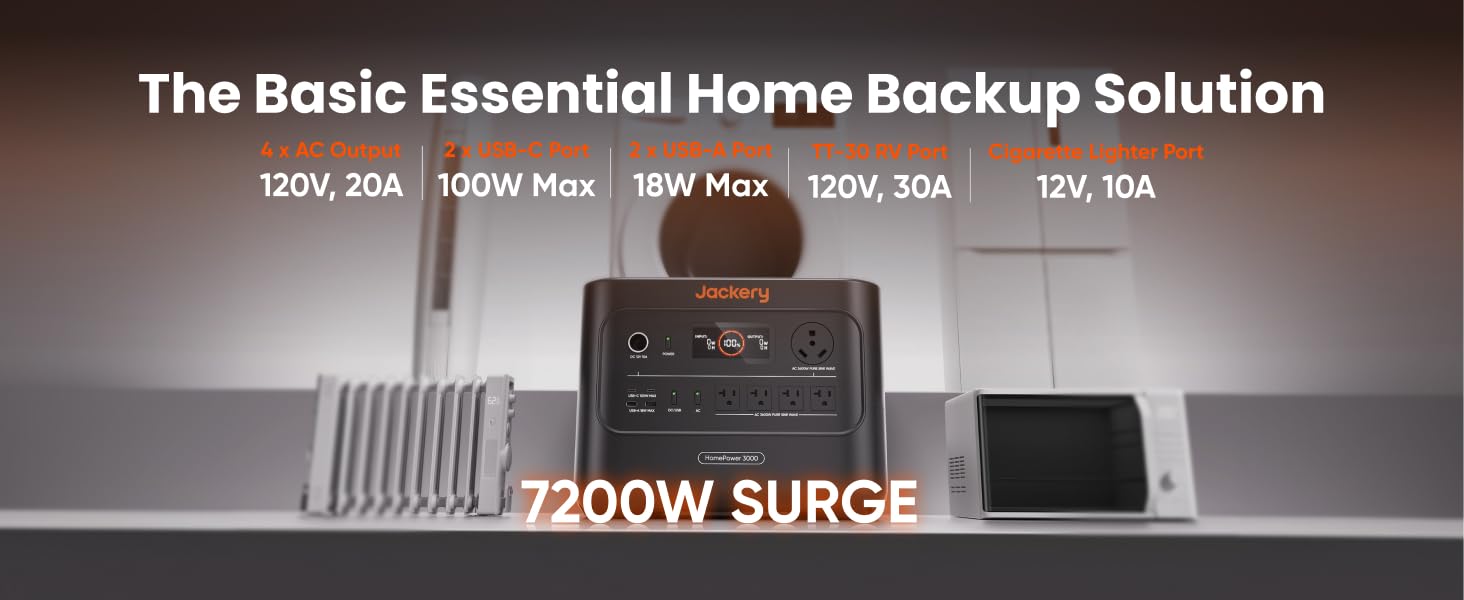
Motors are drama queens. A fridge compressor, a sump pump, or a table saw can demand two to three times its running wattage for a split second at startup. Many models in this class list surge ratings of roughly 5,000 to 6,000 watts, and that’s what keeps compressors from tripping the system. When you compare any 3000W solar generator, look for the surge figure, not just the headline number.


What Can a 3000 Watt Solar Generator Run?
The short answer: nearly anything you’d plug into a household outlet, a couple of big things at a time. The long answer depends on adding up what you want running together, because that total can’t exceed 3,000 watts.
Kitchen and Home Essentials
Here’s a quick cheat sheet of typical draws. Your actual appliances will vary, so check the sticker on the back.
| Appliance | Typical Running Watts | Fits on a 3000W Unit? |
|---|---|---|
| Refrigerator | 100–800 W (cycles on and off) | Yes, with room to spare. |
| Microwave | 800–1,500 W | Yes. |
| Washing machine | 500–1,200 W | Yes. |
| Window AC unit | 500–1,500 W | Yes. |
| Space heater | ~1,500 W | Yes, but it drains the battery fast. |
| Hair dryer | 1,000–1,800 W | Yes, briefly. |
| Vacuum cleaner | 600–1,200 W | Yes. |
| LED TV | 60–250 W | Easily |
| Laptop and router | 50–100 W | Barely a blip |
Notice that you can run a fridge, a TV, a laptop, and some lights together and still be under 1,000 watts. That’s why a solar generator 3000 watts strong feels so generous during a typical outage. Just don’t start the microwave and a hair dryer at the same moment unless you enjoy overload alarms.
Power Tools and Job Sites
Contractors love this class of machine because it’s quiet and fume-free. A circular saw pulls around 1,400 watts, and a heavy-duty drill about 800. Even a small welder, which typically asks for 2,000 to 2,500 watts, can work on a 3000 watt solar generator in short bursts. Run two tools at once and add up the numbers first. Your tools are fine with it, but the inverter has limits.
What a 3000W Solar Generator Can’t Handle
Let’s be honest about the limits. Central air conditioning, electric dryers, electric ranges, and electric water heaters all want 3,000 to 5,000 watts or more on their own. A single 3000-watt solar generator won’t run them, at least not without pairing units or stepping up to a bigger system. A big well pump can also be a problem, depending on its startup surge. If your home leans on any of these, plan around them rather than hoping.
How We Tested and Scored These 3000W Solar Generators
Full transparency: you won’t find a thermal-camera lab here. Our scores come from a repeatable process built on three layers.
- Spec verification. We cross-checked output, capacity, surge rating, solar input limits, and weight against each manufacturer’s own spec sheet. We also compared the 2026 product lineups for current model names.
- Independent hands-on evidence. We leaned on published field tests. One outlet, for example, ran the Jackery 3000 Pro for two weeks and cycled it fully three times. We also weighed owner feedback and long-term reliability reports.
- Runtime and solar math. We ran the same load scenarios across every model: fridge-only, work-from-home, workshop, and RV. We assumed roughly 85% usable efficiency and realistic sun hours.
Each unit was then scored from 1 to 10 on five criteria: power output, battery capacity, portability, solar charging speed, and value. Your own scores may differ if your priorities do. A van-lifer should weigh portability heavily, and a homeowner will care more about expandability.

Best Solar Generator 3000 Watts Models Compared (2026)
Here’s how the leading contenders stack up on paper. Prices swing constantly with sales, so check the manufacturer’s site before you buy.
| Model | Continuous Output | Battery | Standout Feature | Best For |
|---|---|---|---|---|
| Jackery Explorer 3000 Pro | 3,000 W | 3,024 Wh | ~64 lb, fast charging, easy setup | All-round home and RV use |
| EcoFlow DELTA Pro | 3,600 W | 3,600 Wh | Expandable ecosystem | Serious home backup |
| Anker SOLIX F3000 | 3,600 W | 3,072 Wh | 30A RV outlet | RVs and essential backup |
| BLUETTI AC300 + battery module | 3,000 W | Up to ~5,100 Wh | Modular, multiple charging routes | Growing off-grid systems |
| Jackery Explorer 2000 Plus | 3,000 W | 2,042 Wh | 1,200 W solar input, expandable | Budget-minded buyers |
1. Jackery Explorer 3000 Pro
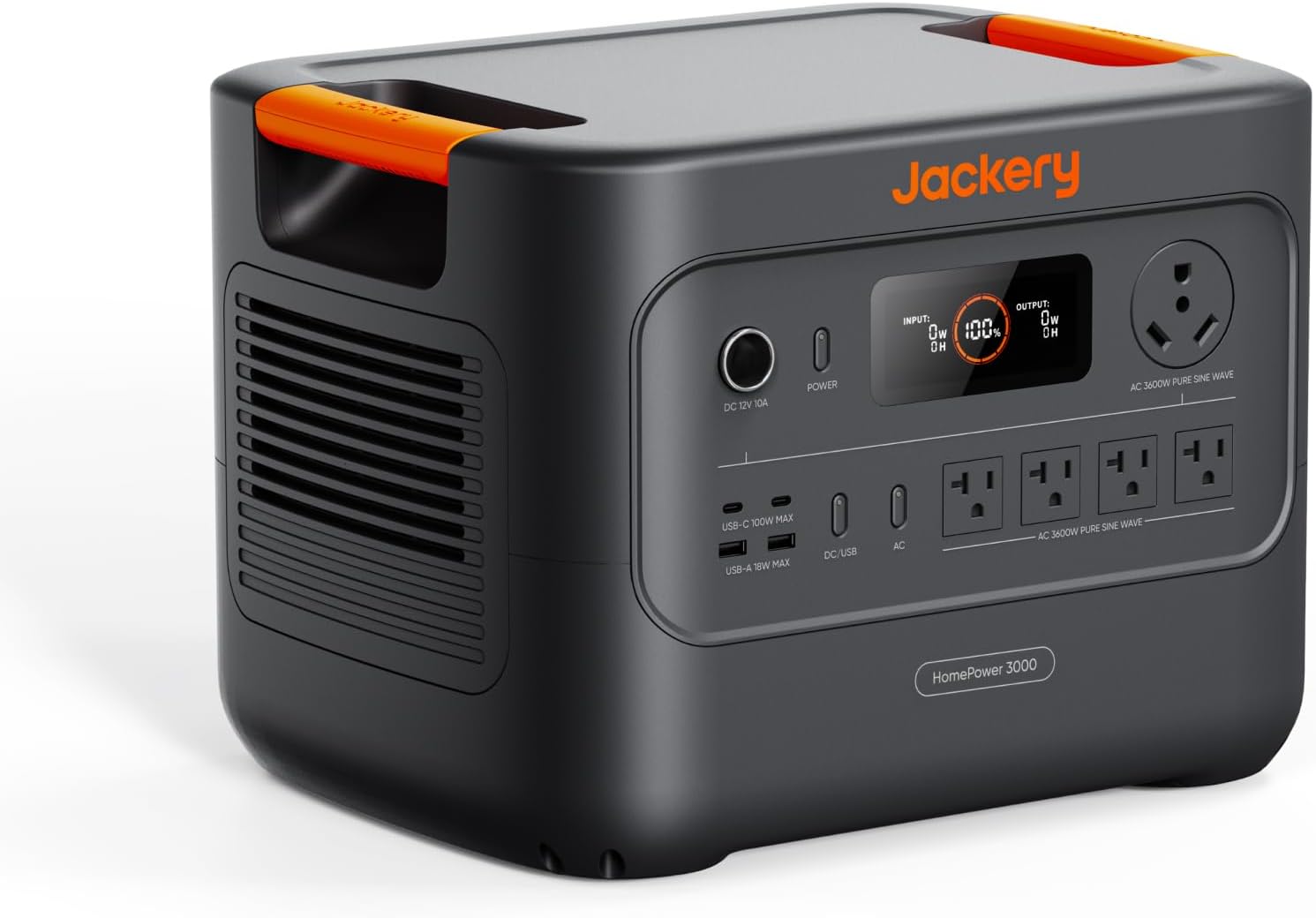
If someone asked me for one safe pick, this is it. It puts out the full 3,000 watts, packs about 3,000 watt-hours, and weighs around 64 pounds, which is hefty but manageable with a cart. A hands-on tester praised its near-zero setup and its ability to power around ten devices at once. The trickiest part was simply positioning the panels. The list price has been quoted near $3,299, so wait for a sale.
2. EcoFlow DELTA Pro
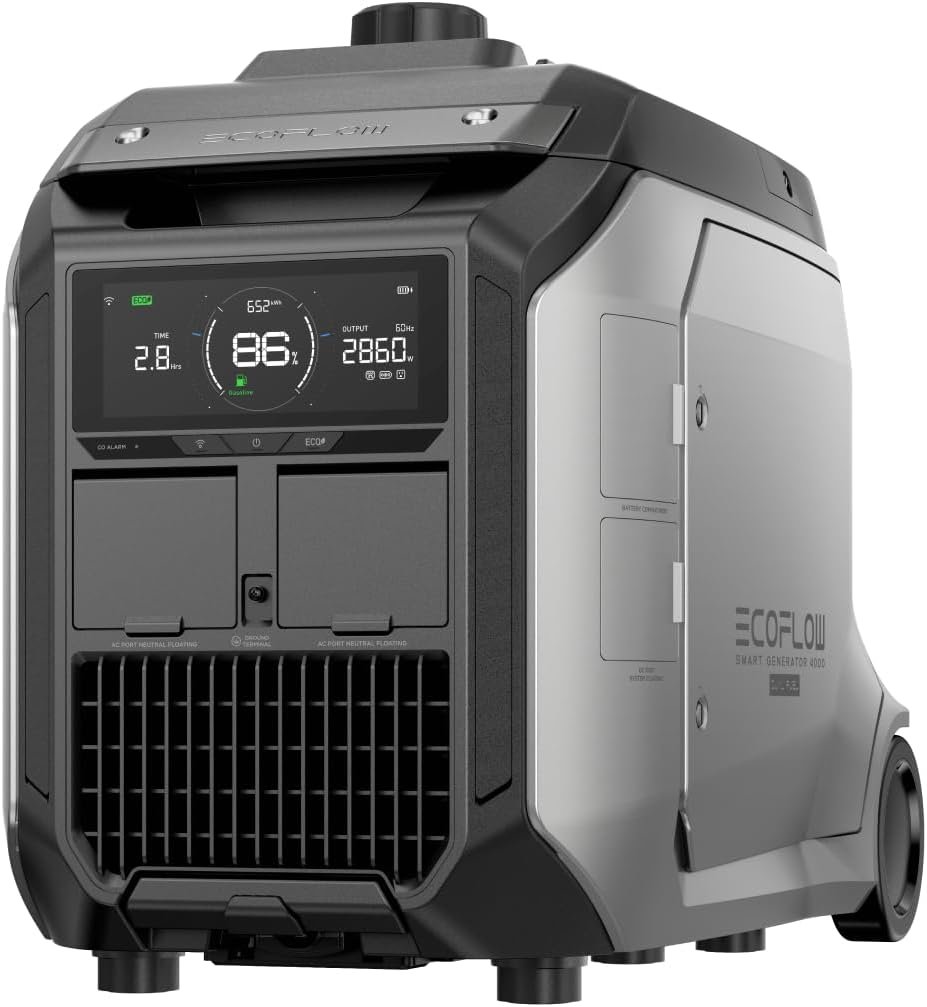
This one is the heavyweight in the ecosystem. It offers 3,600 watts and 3,600 watt-hours, and it expands with extra batteries, which makes it a strong whole-home backup anchor. Its newer sibling, the DELTA Pro 3, stretches to about 4,000 watts and 4,096 watt-hours for people who want headroom. Expect to pay more than average.
3. Anker SOLIX F3000
The F3000 earns its keep with a 30A RV outlet delivering up to 3,600 watts. If you camp in a rig, that matters more than any spec-sheet bragging. It also works well as essential-circuit backup at home.
4. BLUETTI AC300 + Battery Module
Bluetti loves modularity. The AC300 is a base inverter that you grow by snapping on battery modules, and it supports several ways to recharge, from solar to car to wall. Pair it with a module, and you land around 5,100 watt-hours. It’s a good bet if you suspect your needs will grow.
5. Jackery Explorer 2000 Plus: The Value Alternative
Technically, it’s a 2,042-watt-hour unit, but its 3,000-watt output and 1,200-watt solar input make it a strong, cheaper cousin. It expands up to 12 kilowatt-hours with add-on packs, and it has been listed around $1,099. For short, punchy loads, it punches above its price.
How Long Does a 3000W Solar Generator Last? The Runtime Math
Here’s the formula I use, and it fits on a napkin: usable watt-hours ÷ load in watts = hours of runtime. For a 3,000 watt-hour battery, usable energy is roughly 2,550 watt-hours after inverter losses.
| Load | Approx. Runtime on 3,000 Wh |
|---|---|
| Laptop, router, lights (~100 W) | ~25 hours |
| Refrigerator (~1.5 kWh per day) | ~1.5 to 2 days |
| Microwave (1,000 W) | ~2.5 hours of cooking |
| Space heater (1,500 W) | ~1.7 hours |
| Everything at 3,000 W | ~50 minutes |
See why watt-hours matter? The same machine runs a fridge for days or a heater for an afternoon. Your battery is a bank account, and big appliances are expensive purchases.
Solar Panels for a 3000 Watt Solar Generator: How Many Do You Need?
Panels are the other half of the “solar” in solar generators, and many brands sell them separately, so you get to choose. Three 400-watt panels give you 1,200 watts, which matches the input ceiling on units like the Jackery 2000 Plus.
Here’s the realistic math. At about 4.5 peak sun hours and roughly 75% real-world efficiency, 1,200 watts of panels deliver around 4 kilowatt-hours per day. That’s enough to refill a 3,000 watt-hour battery in about one good sunny day.
Cloudy weather, bad angles, and shade will stretch that. Before you buy, check two things: the generator’s maximum solar input in watts and its voltage limit. Exceeding either is the fastest way to waste money.
Jackery Stores
| USA | United Kingdom | Germany | Canada |
|---|---|---|---|
 |  |  |  |
| View Special Offers | View Special Offers | View Special Offers | View Special Offers |
Is a 3000-Watt Solar Generator Enough for Home Backup?
For essentials, absolutely. For everything, no. A 3000-watt solar generator rated at 3000 watts can carry a fridge, freezer, lights, internet, phone charging, a TV, and a fan or window AC through a typical outage. Think of it as a lifeboat, not a cruise ship.
Make a short list of must-run loads, total their watts, and make sure the combined figure sits well under 3,000. If you want to feed a home circuit panel, hire a licensed electrician to install a proper transfer switch. Never backfeed a house through a regular outlet.
RV, Camping, and Job Site Use
On the road, weight and plug types matter more than raw specs. A 3000 watt solar generator with a 30A RV port, like the Anker F3000, drops straight into a rig. Campers can get away with something smaller, but for glamping, remote work, or running an induction cooktop, 3,000 watts is delightful. At 60-plus pounds, though, it’s more “trunk” than “backpack.”
3000W vs. 5000W Solar Generator: Which Size Is Right?
Bigger isn’t always better. A 5,000-watt system can run larger loads and more of them at once, but it’s heavier, pricier, and often overkill. A 3000W solar generator handles essentials and most tools while staying relatively portable. If you need central AC or an electric dryer, step up. If you don’t, save the cash and buy more solar panels instead.
Buying Checklist: What to Look for in a 3000W Solar Generator
Before you click “buy,” run through these:
- Battery chemistry: Choose LiFePO4 for long cycle life and safety.
- Pure sine wave inverter: It’s easier on sensitive electronics.
- Expandability: Can you add batteries later?
- Solar input rating: Higher watts mean faster refills.
- Outlet mix: Look for 120V AC, a 30A port if you RV, USB-C, and a car outlet.
- UPS switchover: Handy if you want it to take over during a blackout.
- Weight and wheels: Be honest about who’s lifting it.
- App and warranty: Real-time monitoring and multi-year coverage are worth the extra.
Is a Solar Generator 3000 Watts Worth the Money?
The upfront price stings. Units in this class range from about $1,000 on a good sale to $3,000 and up for premium flagships. But the fuel is free, the maintenance is nearly zero, and nothing leaks or smells. Over years of storms and camping trips, it adds up.
Gas generators win on cheap upfront cost and refueling speed. A solar unit wins on quiet, safety, and the simple joy of not hunting for gasoline during a hurricane.
Conclusion
So, is a solar generator 3000 watts right for you? If you want dependable essentials backup, quiet jobsite power, or a comfortable RV setup, yes. It’s the sweet spot where power, portability, and price meet. Just remember the two golden numbers: watts decide what you can run, and watt-hours decide how long.
Pair the right 3000-watt solar generator with enough panels and a realistic load list, and you’ll sleep fine the next time the lights go out. Pick your priority, whether that’s Jackery’s simplicity, EcoFlow’s expansion, Anker’s RV-ready ports, or Bluetti’s modularity, and buy with confidence.
Score Box: Solar Generator 3000 Watts (Class Overall)
| Category | Score |
|---|---|
| Power Output | 9.5 / 10 |
| Battery Capacity | 8.5 / 10 |
| Portability | 6.5 / 10 |
| Solar Charging Speed | 8.5 / 10 |
| Value for Money | 8.0 / 10 |
| Overall | 8.2 / 10 |
FAQs About Solar Generator 3000 Watts
Can a 3000 watt solar generator run a whole house?
Not entirely. It can keep essential circuits alive, such as the fridge, lights, internet, and a window AC. Big loads like central air, electric dryers, and electric water heaters exceed its output unless you pair multiple units or upgrade.
How many solar panels do I need to charge a 3000W solar generator?
Around 1,000 to 1,200 watts of panels (three 400-watt panels, for example) can recharge a roughly 3,000 watt-hour battery in about a sunny day. Always stay within the generator’s maximum solar input and voltage limits.
How long will a 3000 watt solar generator run a refrigerator?
Typically a day and a half to two days on a 3,000 watt-hour battery, depending on how efficient your fridge is and how often you open it. Adding solar during daylight can stretch that much further.
Is it safe to use a solar generator indoors?
Yes, in general. Nothing burns, so there’s no carbon monoxide. Keep it ventilated, dry, and away from heat, and follow the manufacturer’s guidance.
Can I expand the battery on a 3000W solar generator?
Many models can. EcoFlow, Bluetti, Anker, and Jackery all sell expansion batteries for select units, which lets you start small and grow. Confirm compatibility before you buy.
| Power Station for Camping Near You | |
|---|---|
 |  |
| Get Amazon Special Offers | Get Walmart Special Offers |
You Might Also Like: