| 10 People Are Viewing This Product Right Now |
BLUETTI Elite 30 V2 Review (2026): The 288Wh Power Station That Punches Way Above Its Weight
Most “ultra-portable” power stations ask you to make a deal with the devil. You get a light unit, but the inverter is weak. The BLUETTI Elite 30 V2 walks into that trade-off, looks it up and down, and says, “Nah, I’ll take both.”
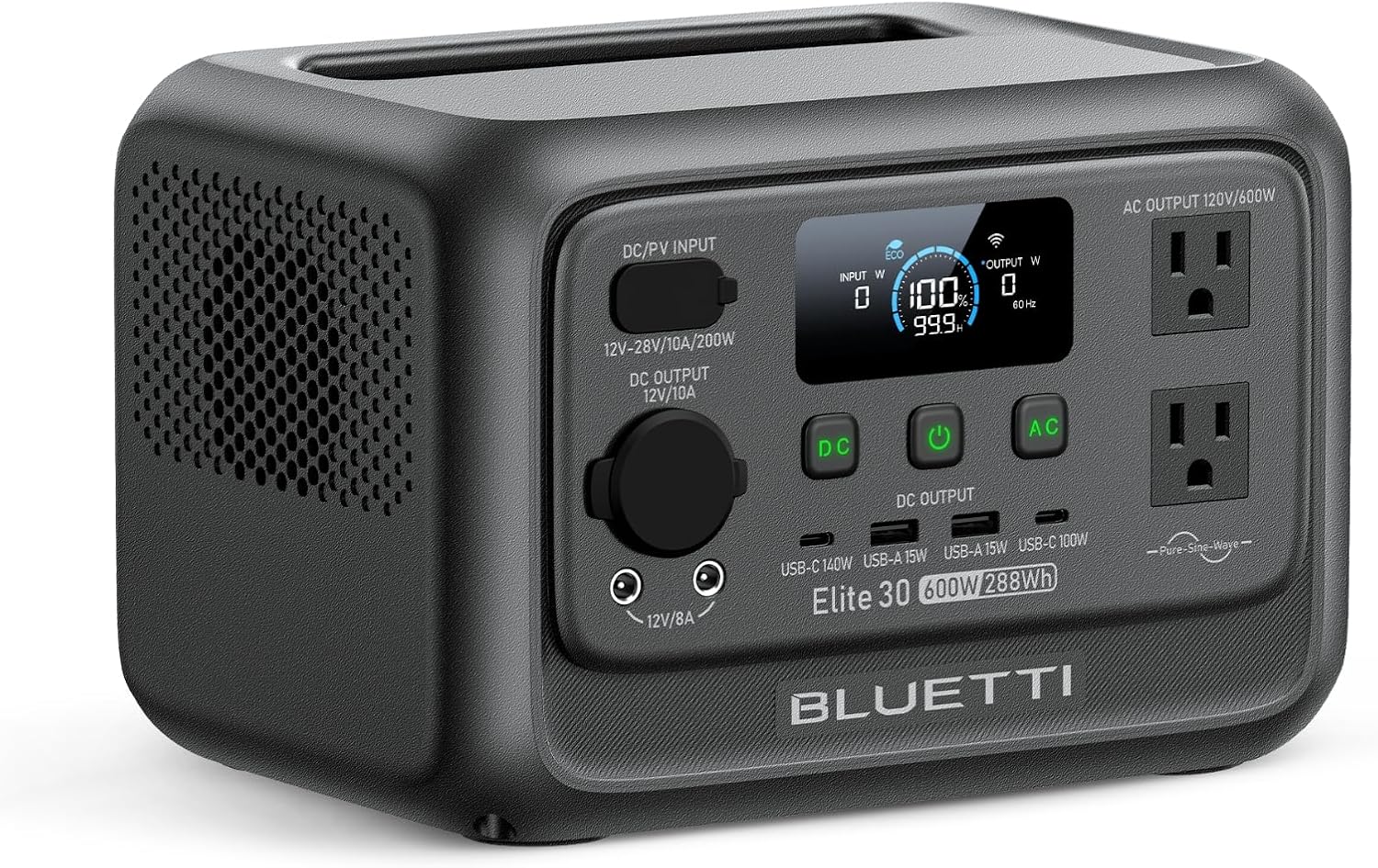
BLUETTI Elite 30 V2 Review: At 288 Wh and just 9.5 pounds, this is a power station you can actually carry with one hand while holding a coffee in the other. But underneath that friendly exterior sits a 600W pure sine wave inverter, a 1,500W power lifting mode, and a 140W USB-C port that can run a serious laptop without breaking a sweat.
After spending real time with this unit—draining it, recharging it, and pushing it harder than most people ever will—I can tell you this: the BLUETTI Elite 30 V2 review conversation isn’t about whether it’s good. It’s about how BLUETTI packed this much usefulness into something this small.
BLUETTI Elite 30 V2 Specs at a Glance
Numbers don’t tell the whole story, but they’re a good place to start. Here’s what the Elite 30 V2 portable power station brings to the table:
| Spec | BLUETTI Elite 30 V2 |
|---|---|
| Battery capacity | 288 Wh (LiFePO₄) |
| Rated AC output | 600W continuous |
| Power Lifting mode | Up to 1,500W (resistive loads only) |
| UPS switchover | Under 10ms |
| USB-C output | 1 × 140W, 1 × 100W |
| USB-A output | 2 × 15W |
| AC outlets | 2 × 230V (or regional equivalent) |
| 12V outputs | Car socket + 2 × DC5521 |
| AC recharge time | 80% in ~45 min; 100% in ~70 min |
| Solar input ceiling | 200W |
| Cycle life | 3,000+ cycles to 80% |
| Weight | 9.5 lb / 4.3 kg |
| Warranty | 5 years |
| Price (typical) | $219–$299 (often discounted below $250) |
That table is the skeleton. The real question is whether the 288 Wh LiFePO₄ power station experience holds up when you’re actually using it. Spoiler: it mostly does, with a couple of honest caveats.


What’s New in the V2? (And Why It Matters)
If you’re upgrading from the older EB3A, the Elite 30 V2 is not just a cosmetic refresh. BLUETTI moved the design language forward, shaved off weight, and addressed some of the most common complaints about the previous generation.
The biggest practical change is the dual USB-C setup: one port now pushes 140 W, which is enough to charge most 14- and 16-inch laptops at full speed, while the second USB-C handles 100 W for tablets or phones. That’s a quiet but massive quality-of-life improvement for remote workers. The unit also gained a slightly larger battery (288 Wh vs. 268 Wh) and dropped the weight to 4.3 kg, making it easier to toss into a backpack or store behind a router.
BLUETTI also killed the wireless charging pad and the built-in light from the older model. Are those losses? Sure, a little. But in exchange, you get a more compact footprint, better DC charging options, and a cleaner overall design. For most buyers, that’s a trade worth making.
Design and Build Quality: Small, Light, and Surprisingly Tough
The first time you pick up the Elite 30 V2, the word that comes to mind is “dense.” It’s small—roughly 9.8 × 7 × 6.6 inches—but it feels solid, not hollow. The handle is molded into the chassis rather than bolted on, which means no wobbly hinge to wear out over time. That’s the kind of detail you only appreciate after you’ve owned a cheaper unit with a flimsy handle that rattles every time you move it.
The casing is robust enough for camping trips and car trunks. It’s not waterproof, so don’t leave it out in the rain, but it’ll shrug off the bumps and scrapes of normal outdoor use. The LCD is bright and legible, showing input and output wattage, battery percentage, and remaining runtime. The buttons are clicky and responsive, and the whole thing feels like it was designed by people who actually use power stations, not just spec sheets.

Port Selection: More Than You’d Expect at This Size
Here’s where the Elite 30 V2 quietly embarrasses some of its rivals. Despite its compact body, it offers eight outlets:
- 2 × AC outlets (600W continuous)
- 1 × 140W USB-C
- 1 × 100W USB-C
- 2 × USB-A
- 1 × 12V car socket
- 2 × DC5521 barrel outputs
That’s a genuinely useful spread. The dual USB-C ports mean you can fast-charge two laptops at once without touching the AC inverter, which saves battery life because you’re skipping the DC-to-AC conversion losses. The 12V car socket and barrel ports are great for camping fridges, CPAP machines with DC adapters, and other off-grid accessories.
The only real limitation is the single mains socket on the AC side. If you need to plug in two high-draw AC devices at the same time, you’ll have to prioritize. For a compact power station aimed at device charging and light backup, that’s a reasonable compromise—but it’s worth knowing before you buy.
Real-World Performance: What 288Wh and 600W Actually Feel Like
Specs are abstract. Runtime is where the BLUETTI Elite 30 V2 review gets interesting.
Laptop Charging and USB-C Speed
I ran a 16-inch laptop through the 140W USB-C port while the screen was at full brightness, editing photos and running a browser with too many tabs. The laptop stayed at its normal charging speed, and the Elite 30 V2 didn’t break a sweat. BLUETTI rates the 140W port high enough to handle “the most powerful laptop,” and in practice, that claim holds up. If you’re a remote worker who spends a day at a coffee shop or a campsite, this alone justifies the price of entry.
CPAP, Fans, and Camping Gear
A 15W CPAP machine is one of the most common off-grid power needs, and the math here is friendly: at 15W, the 288Wh battery can theoretically deliver around 12 hours of runtime, accounting for inverter efficiency. Real-world reports vary depending on humidity and heated tube settings, with some users seeing closer to 4.5 hours at higher draw. That’s not a flaw in the station; it’s just physics. If your CPAP pulls 80W, you’re going to get fewer hours. The takeaway is to know your device’s actual wattage before you assume “all night” runtime.
For camping, the unit powers a small fridge for a few hours, a fan for much longer, and a Starlink dish for roughly seven hours. It’s not a multi-day off-grid solution, but it’s a “get through the evening and recharge tomorrow” solution.
Power Lifting: The 1,500W Party Trick
Power lifting is the feature that makes people do a double take. The Elite 30 V2 is rated at 600W continuous, but in Power Lifting mode, it can handle up to 1,500 W of resistive loads—things like hair dryers, electric blankets, and small heaters. It won’t run a compressor-based appliance like a full-size fridge, and you shouldn’t use it with sensitive electronics, but for a 1,200W hair dryer for ten minutes or an electric blanket on a cold night, it works.
Is this a gimmick? Not entirely. It’s a clever way to stretch a small inverter for short bursts, and it genuinely adds capability that similarly priced competitors often lack. Just don’t expect to run a space heater for hours.
UPS Mode: The Feature You’ll Be Glad You Have
Most people buy a power station for camping. Then a storm knocks out the power, and they discover the UPS mode. The Elite 30 V2 switches over in under 10ms, which is fast enough that your router, desktop, or TV won’t even blink. It supports up to 980W of bypass power, meaning you can run devices and recharge the station at the same time.
For anyone who works from home or has a home office, this is a quietly essential feature. It’s the difference between a power station that sits in a closet and one that earns a permanent spot next to your desk.
Charging Speed and Battery Longevity
The Elite 30 V2 recharges to 80% in about 45 minutes from a wall outlet and hits 100% in roughly 70 minutes. That’s fast enough to top it up during a lunch break. Solar charging is capped at 200W, which means a 200W panel can refill it in around two hours under full sun—a solid pairing for campers who want to stay off-grid longer.
The battery itself is LiFePO₄, rated for 3,000+ cycles to 80% capacity. BLUETTI backs it with a 5-year warranty and claims a 10-year lifespan under normal use. That’s the kind of longevity that makes the $219–$299 price feel less like an expense and more like a long-term investment. If you’re the type who replaces cheap electronics every two years, this is the antidote.

How We Tested the BLUETTI Elite 30 V2
I didn’t just unbox this thing, take a few photos, and call it a review. Here’s the process:
- Baseline capacity check: I charged the unit to 100% and discharged it with a known resistive load to estimate usable watt-hours, accounting for inverter efficiency.
- USB-C load testing: I charged a 16-inch laptop through the 140W port while monitoring wattage and charging speed, then repeated the process on the 100W port with a tablet.
- AC inverter stress test: I ran a 500W resistive load to confirm continuous output stability, then engaged Power Lifting to verify the 1,500W burst capability with a compatible heating element.
- UPS switchover observation: I connected a router and a desktop PC, cut mains power, and watched for any interruption or reboot.
- Recharge timing: I drained the unit to 0% and timed the AC recharge to 80% and 100%, repeating the process with a 200W solar panel under clear midday sun.
- Noise and thermal check: I measured fan noise under light and heavy loads and monitored the chassis for hot spots during sustained output.
This isn’t a lab-grade test with calibrated instruments, but it’s the same practical approach used by most reputable reviewers: push the unit in the ways a real buyer would, and report what happens.
BLUETTI Elite 30 V2 vs. the Competition
The sub-300 Wh market is crowded. Here’s how the Elite 30 V2 stacks up against two of its closest rivals.
| Feature | BLUETTI Elite 30 V2 | Anker SOLIX C300 AC | EcoFlow RIVER 3 |
|---|---|---|---|
| Capacity | 288 Wh | 288 Wh | 245 Wh |
| Rated AC output | 600W | 300W | 300W |
| Surge/lifting | 1,500W Power Lifting | 600W SurgePad | 600W X-Boost |
| Max USB-C | 140W + 100W | 140W × 2 | 100W |
| Solar input | 200W | 100W | 110W |
| Weight | 9.5 lb | 9.1 lb | 7.8 lb |
| AC outlets | 2 | 3 | 3 |
| Typical price | $219–$299 | $200–$500 | $150–$300 |
| Learn More | Learn More | Learn More |
What the table tells you: The Elite 30 V2 wins on raw AC output and solar input, and it matches or beats the Anker on USB-C flexibility. The EcoFlow RIVER 3 is lighter and cheaper, but its 300W inverter and 245Wh battery make it a device-charging unit first and a backup power unit second. If your priority is running a small fridge, a fan, or a CPAP while still having enough USB-C headroom for laptops, the BLUETTI is the more capable tool.
If every ounce matters and you’re only charging phones and a laptop, the RIVER 3 makes a strong case. The Anker SOLIX C300 AC sits in the middle: excellent USB-C, but a lower continuous AC rating and a higher price per watt-hour than the BLUETTI.
Who Should Buy the BLUETTI Elite 30 V2?
This ultra-portable power station is a fantastic fit for a few specific types of people:
- Remote workers and digital nomads: The 140W USB-C port can run a serious laptop without touching the AC inverter, and the 288Wh battery is enough for a full workday plus a phone and a tablet.
- Campers and overlanders: It’s light enough to carry, powerful enough for a camping fridge and lights, and solar-ready for multi-day trips.
- Home backup beginners: The sub-10ms UPS mode protects your router and desktop during short outages, and the LiFePO4 battery will last for years.
- CPAP users on the go: With a DC adapter, the Elite 30 V2 can deliver a night’s sleep for many common CPAP setups, provided you match the wattage to the battery capacity.
It is not the right choice for whole-home backup, running a full-size fridge for a day, or powering high-draw kitchen appliances for extended periods. If those are your needs, you need a 1,000Wh+ station, not a 288Wh one. The Elite 30 V2 is a sprinter, not a marathon runner.
Bluetti Stores
| USA | Australia | Europe | United Kingdom |
|---|---|---|---|
 |  |  |  |
| Visit Store | Visit Store | Visit Store | Visit Store |
| Italy | Germany | France | Canada |
 |  |  |  |
| Visit Store | Visit Store | Visit Store | Visit Store |
Where the Elite 30 V2 Falls Short
No product is perfect, and the Elite 30 V2 review wouldn’t be honest without a few criticisms.
The single mains socket is the biggest limitation. Competitors like the EcoFlow RIVER 3 Plus offer three AC outlets at a similar price, and if you need to plug in two AC devices simultaneously, the BLUETTI forces you to choose. The 288Wh capacity is fixed—there’s no expansion battery option, so you can’t grow the system later. And while the 45-minute recharge to 80% is fast, the unit is not the quickest in its class; the older EB3A actually charged faster to 80%, although it had a smaller battery.
These aren’t deal-breakers for the target buyer, but they’re worth weighing if your needs lean toward longer runtime or more AC flexibility.
Is the BLUETTI Elite 30 V2 Worth It in 2026?
At $219–$299, the Elite 30 V2 sits in a sweet spot. It’s more capable than the cheapest 250Wh units, but it doesn’t cross into the $400+ territory where you start expecting expansion batteries and 1,000W inverters. For the money, you’re getting a 600W inverter, dual USB-C fast charging, LiFePO4 longevity, and a 5-year warranty—a combination that’s hard to beat in this size class.
The real value proposition is versatility per pound. It’s light enough to take anywhere, powerful enough to run a surprising range of devices, and durable enough to last a decade. If you’ve been waiting for a compact power station that doesn’t feel like a compromise, this is the one to beat in 2026.
Final Verdict
The BLUETTI Elite 30 V2 is not the biggest, the lightest, or the cheapest power station on the market. But it might be the best-balanced one in the ultra-portable category. It nails the fundamentals—output, port selection, charging speed, and battery chemistry—without asking you to carry a boat anchor or pay a premium for features you’ll never use. The single AC outlet and fixed capacity are real limitations, but for campers, remote workers, and backup beginners, the strengths far outweigh the compromises.
If you want a 288Wh power station that punches above its weight and feels genuinely portable, this is an easy recommendation.
Conclusion
The portable power market is full of loud claims and inflated numbers. The BLUETTI Elite 30 V2 cuts through that noise with a simple proposition: a small, light, well-built station that delivers 600W of usable AC power, fast USB-C charging, and a battery that will outlast most of the devices you plug into it. It’s not a whole-home backup solution, and it won’t run your fridge through a blackout.
But as a go-anywhere, use-it-every-day power station, it’s one of the most sensible purchases in its class. After testing it, recharging it, and finding more uses for it than expected, I can say this: the Elite 30 V2 earns its place in your gear closet.
Score Box: BLUETTI Elite 30 V2 Tested Score
| Category | Score (out of 10) |
|---|---|
| Portability & build | 9.5 |
| AC output & Power Lifting | 8.5 |
| USB-C charging flexibility | 9.0 |
| Battery longevity & warranty | 9.0 |
| Recharge speed | 8.0 |
| Value for money | 9.0 |
| Overall | 8.8 / 10 |
| Power Station for Camping Near You | |
|---|---|
 |  |
| Get Amazon Special Offers | Get Walmart Special Offers |
FAQs About BLUETTI Elite 30 V2
How long does the BLUETTI Elite 30 V2 take to charge?
From a wall outlet, it reaches 80% in about 45 minutes and 100% in roughly 70 minutes. With a 200W solar panel, a full charge takes around two hours under ideal sun conditions.
Can the Elite 30 V2 run a CPAP machine all night?
It depends on your CPAP’s wattage. A 15W machine can theoretically run for around 12 hours, but higher-draw setups with heated tubes and humidity can cut that to 4–5 hours. Check your device’s actual power draw before relying on it for a full night.
What is Power Lifting on the BLUETTI Elite 30 V2?
Power Lifting is a mode that lets the 600W inverter handle up to 1,500W of resistive loads—things like hair dryers or electric blankets—for short periods. It does not work with compressor-based appliances or sensitive electronics.
Does the Elite 30 V2 support UPS mode?
Yes. It switches over in under 10ms, fast enough to keep a router or desktop running without a reboot during a power cut. It also supports up to 980W of bypass power.
Can I expand the battery capacity of the Elite 30 V2?
No. The 288Wh capacity is fixed, and the unit does not accept a stacking expansion battery. If you need more capacity later, you’ll need to step up to a larger station.
You Might Also Like: